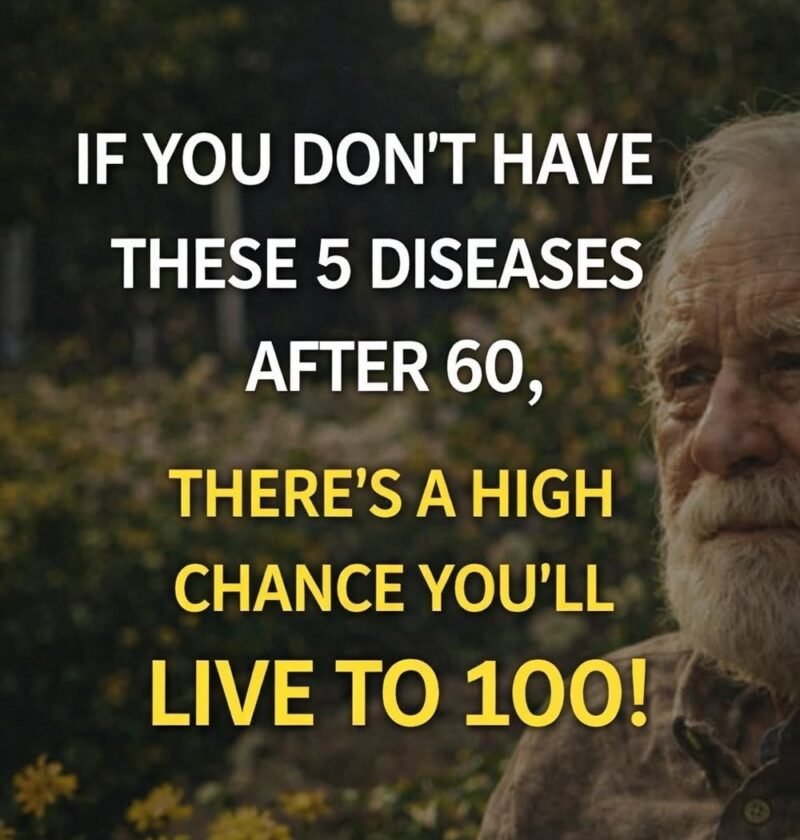
“If You Reach 60 Without These 5 Diseases, You Have a High Chance of Living to 100” — Is It True?
Not exactly. The headline contains a kernel of truth, but it turns a population-level association into a prediction about an individual.
Research does show that people who eventually reach 100 tend to develop major age-related diseases later and, in some cases, avoid them altogether. A large Swedish study following more than 170,000 people from age 60 found that centenarians generally had lower rates of several major diseases than people who died younger. PubMed+1
But being disease-free at 60 does not mean you are likely to reach 100. Genetics, smoking, physical activity, diet, blood pressure, cholesterol, socioeconomic factors, access to healthcare, and plain chance all contribute to longevity. JAMA Network+1
The 5 conditions commonly mentioned in this viral claim
The posts circulating this headline typically focus on:
- Heart disease
- Type 2 diabetes
- Stroke or major circulatory disease
- Cancer
- Chronic lung disease
Avoiding these conditions is certainly beneficial—but there is no validated rule saying that avoiding all five by age 60 gives you a high probability of reaching 100.
Interestingly, studies of actual centenarians show that some people reach 100 despite having chronic illnesses. One U.S. study found that only about 23% of centenarians reached 100 without a major chronic disease, showing why “no disease = guaranteed longevity” is an oversimplification. PubMed Central (PMC)
What you can do after 60
Rather than focusing on whether you have avoided five particular diseases, concentrate on maintaining the factors that are associated with healthier longevity:
- 🚭 Don’t smoke.
- 🚶 Stay physically active and maintain muscle strength.
- 🥗 Eat a predominantly whole-food, nutrient-rich diet.
- ❤️ Keep blood pressure and cholesterol under control.
- 🩸 Manage diabetes if you have it.
- 🧠 Stay socially and mentally active.
- 🩺 Keep up with recommended screening and vaccinations.
- 💊 Take prescribed medications consistently.
A 2024 study of adults aged 80 and older found that those with the healthiest combination of nonsmoking, regular exercise, and greater dietary diversity were more likely to become centenarians. JAMA Network
Bottom line: Reaching 60 without major chronic diseases is a favorable sign, not a guarantee of reaching 100. The goal shouldn’t be simply to live longer—it should be to preserve mobility, independence, cognitive health, and quality of life for as many years as possible.
Sources