When older adults experience temporary neurological glitches, it is easy to brush them off as “just getting older,” fatigue, or a fleeting dizzy spell. However, in clinical medicine, a “mini-stroke”—formally known as a Transient Ischemic Attack (TIA)—is a critical vascular warning sign that demands immediate attention.
A TIA occurs when a blood clot temporarily blocks an artery in the brain before dissolving on its own, causing symptoms that mimic a full stroke but resolve completely within minutes to an hours.
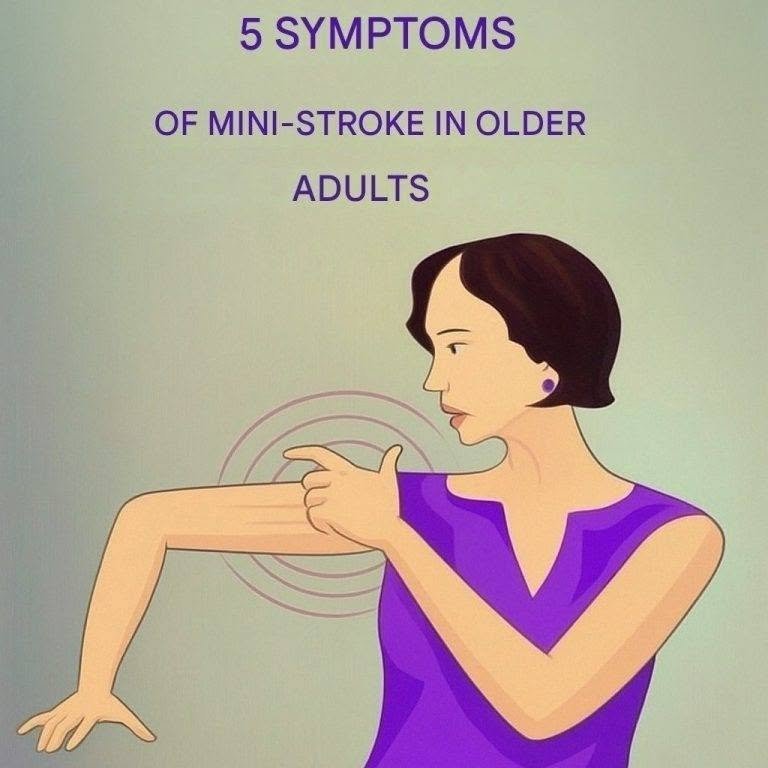
Here are 5 key symptoms of a mini-stroke in older adults that should never be ignored or dismissed as normal aging:
1. Sudden, One-Sided Weakness or Numbness
-
What it looks like: A sudden, heavy feeling, numbness, or loss of strength affecting one vertical half of the body—such as the right arm and right leg drooping or failing to cooperate simultaneously.
-
Why it matters: Unlike age-related arthritis or general muscle weakness that develops gradually over years, a TIA-induced weakness strikes instantly and is strictly localized to one side of the body.
2. Sudden Slurred Speech or Communication Struggles
-
What it looks like: An older adult suddenly sounding thick-tongued, garbled, or finding themselves completely unable to articulate a sentence or understand what family members are saying.
-
Why it matters: Temporary disruption of blood flow to the brain’s language centers (such as Broca’s area) compromises verbal processing. Families often mistake this for sudden confusion or tiredness, but speech deficits are a hallmark red flag.
3. Sudden, Unexplained Loss of Balance or Severe Dizziness
-
What it looks like: A sudden, heavy bout of unsteadiness, stumbling, or vertigo that makes it impossible to walk straight, completely distinct from chronic inner ear issues or mild age-related unsteadiness.
-
Why it matters: When ischemia affects the cerebellum or brainstem—the regions responsible for balance and coordination—it impairs spatial equilibrium.
4. Brief, Sudden Vision Changes in One Eye
-
What it looks like: A sudden blurring, double vision, or a dark “curtain” pulling down over the sight of one eye, which clears up completely a short time later.
-
Why it matters: Because the eyes share direct arterial pathways with the brain via the carotid circulation, temporary vision loss is an early indicator of carotid plaque instability or micro-emboli.
5. Sudden, Uncharacteristic Confusion or Disorientation
-
What it looks like: An abrupt episode where a senior suddenly becomes disoriented about where they are, the time of day, or familiar routines, lasting for a few minutes before snapping back to normal.
-
Why it matters: Widespread or multi-area micro-vascular disruptions can temporarily impair higher-level cognitive executive processing.
The Urgency of a TIA
Because a mini-stroke resolves on its own, many people make the dangerous mistake of staying home and “waiting to see if it happens again.” In reality, a TIA is a major warning shot: clinical studies show that up to 10% of people who suffer a TIA will experience a full-scale stroke within three months, with the highest risk concentrated in the very first few days.
If an older adult experiences any of these sudden symptoms—even if they disappear entirely within 10 minutes—treat it as a medical emergency and call for immediate medical evaluation.
Are you reviewing these signs out of general health awareness, or have you or an older loved one recently noticed any sudden, fleeting neurological changes?