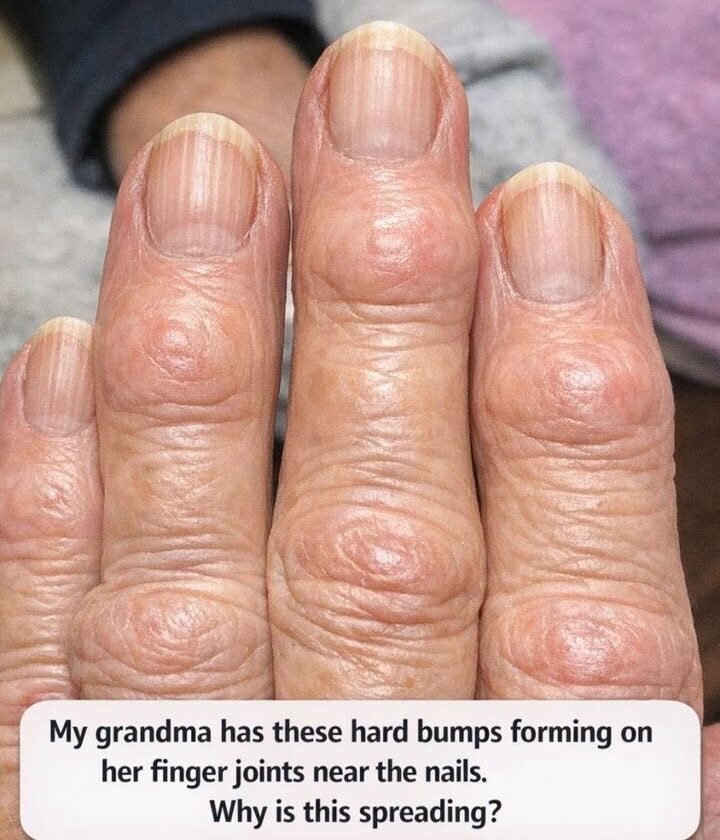
Hard bumps forming on finger joints near the nails in older adults are usually related to underlying wear-and-tear arthritis, and they often appear on multiple fingers over time.
Two common conditions frequently cause hard bumps in this exact location:
1. Heberden’s Nodes (Osteoarthritis Bumps)
-
What they are: These are bony enlargements that form specifically at the DIP joints (the distal interphalangeal joints, which are the joints closest to the fingernails).
-
Why they feel hard: They are bony spurs (osteophytes) that develop as a result of osteoarthritis, where the protective cartilage cushioning the joint wears down over time.
-
Why it seems to be “spreading”: Osteoarthritis is a systemic joint process, not an infection. It frequently affects multiple fingers across both hands symmetrically or sequentially, making it look like the bumps are popping up on one finger after another.
2. Digital Mucous Cysts (Ganglion Cysts of the Finger)
-
What they are: If the bumps are somewhat smooth, dome-shaped, and located right at the base of the nail or directly over the joint near the nail, they can be mucous cysts.
-
The Arthritis Connection: These cysts are actually closely linked to underlying arthritis in that same joint. Joint fluid leaks out through a small defect in the joint capsule and collects under the skin, forming a firm lump. Because the underlying arthritis is often present in multiple fingers, cysts can occasionally develop on more than one digit.
What Your Grandma Should Do
While Heberden’s nodes and mucous cysts are common and generally non-urgent, they can sometimes cause mild stiffness, tenderness, or—in the case of cysts near the nail matrix—groove the fingernail as it grows.
-
Consult a Doctor or Rheumatologist: It is important to have a physician evaluate her hands to confirm whether this is classic osteoarthritis or another form of arthritis (like inflammatory or psoriatic arthritis, which can also affect the fingers).
-
Protect the Skin: If the bumps are mucous cysts, she should never attempt to pop or squeeze them at home, as the skin over them is very thin and doing so can introduce bacteria straight into the joint, leading to a serious infection.