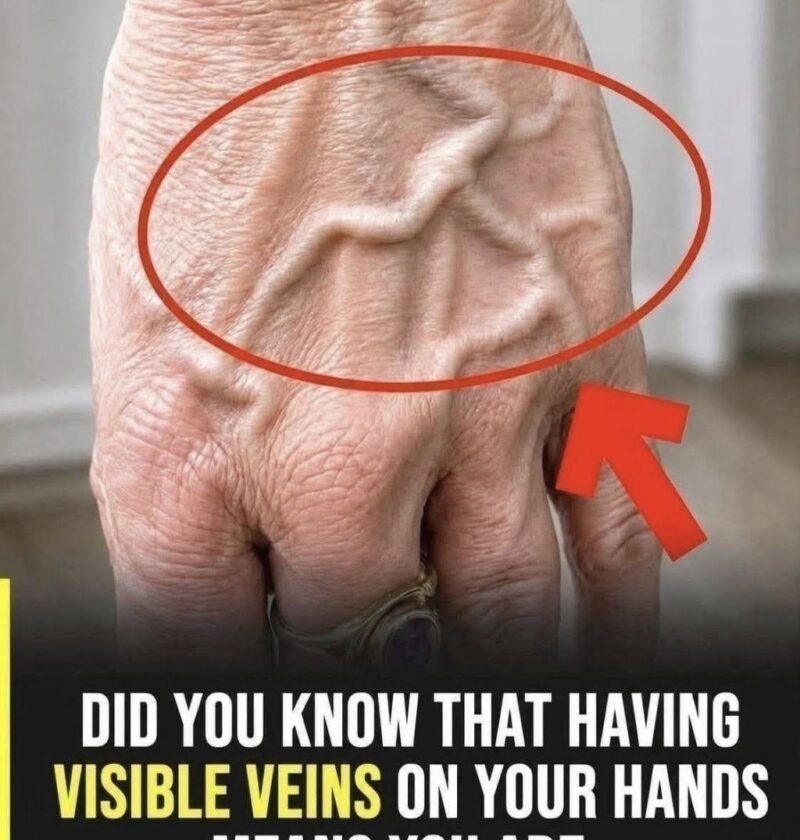
When viral clickbait headlines tease claims like “Did you know that having visible veins means you are…”—often finishing with dramatic hooks about secret health traits, superior fitness, or impending medical disaster—they are relying on generalized myth-making.
In reality, seeing your veins doesn’t mean a single, uniform thing. Whether visible veins are a completely normal physical trait or a sign of an underlying issue depends almost entirely on your body composition, genetics, and where those veins are appearing.
Why Are Veins Visible? The 4 Main Reasons
1. Low Body Fat and Thin Skin (The Fitness Factor)
-
What’s Happening: If you notice prominent veins snaking across your arms, shoulders, or abdomen, it is often a sign of low subcutaneous body fat combined with naturally thin skin. When you have less fat padding between your skin and your circulatory system, your blood vessels sit closer to the surface and become clearly mapped out. This is why athletes and very lean individuals frequently have highly visible vascularity.
2. Genetics and Aging
-
What’s Happening: Just like eye color or height, how close your veins sit to the surface is largely genetic. Furthermore, as we age, our skin naturally loses collagen and thins out, and the elasticity in our blood vessel walls decreases. This makes veins naturally more transparent and prominent, especially on the hands, temples, and feet.
3. Hormones, Heat, and Blood Volume
-
What’s Happening: When you are hot, your blood vessels dilate (expand) to help your body cool down, pushing more blood close to the skin’s surface and making veins look larger. Pregnancy and hormonal shifts also increase overall blood volume and relax blood vessel walls, frequently causing veins to temporarily swell or become more visible.
4. Chronic Venous Insufficiency (Varicose and Spider Veins)
-
What’s Happening: This is where visible veins shift from a cosmetic or structural trait into a medical consideration. If veins in the legs become twisted, bulging, dark, or rope-like (varicose veins), it means the tiny one-way valves inside those veins have weakened. Instead of smoothly pumping blood back up to the heart, blood leaks backward and pools, stretching the vessel wall.
What Viral Myths Get Wrong
-
The “Super-Metabolism” Myth: Viral posts sometimes claim that prominent veins mean your metabolism is hyper-efficient or that you possess a rare biological superpower. In truth, it simply means your fat percentage is low or your skin is thin.
-
The “Toxin Buildup” Myth: Another common internet claim is that visible veins mean your blood is “full of toxins” requiring a special detox cleanse. Your liver and kidneys handle detoxification; visible veins are simply structural pipelines.
⚠️ When to See a Doctor:Normal vascularity (like veins on the hands or arms due to thin skin or fitness) is entirely harmless. However, you should consult a doctor or vein specialist if your visible leg veins are accompanied by aching pain, heaviness, swelling, throbbing, skin discoloration around the ankles, or painful ulcers, as these are classic signs of venous insufficiency that benefit from medical evaluation.