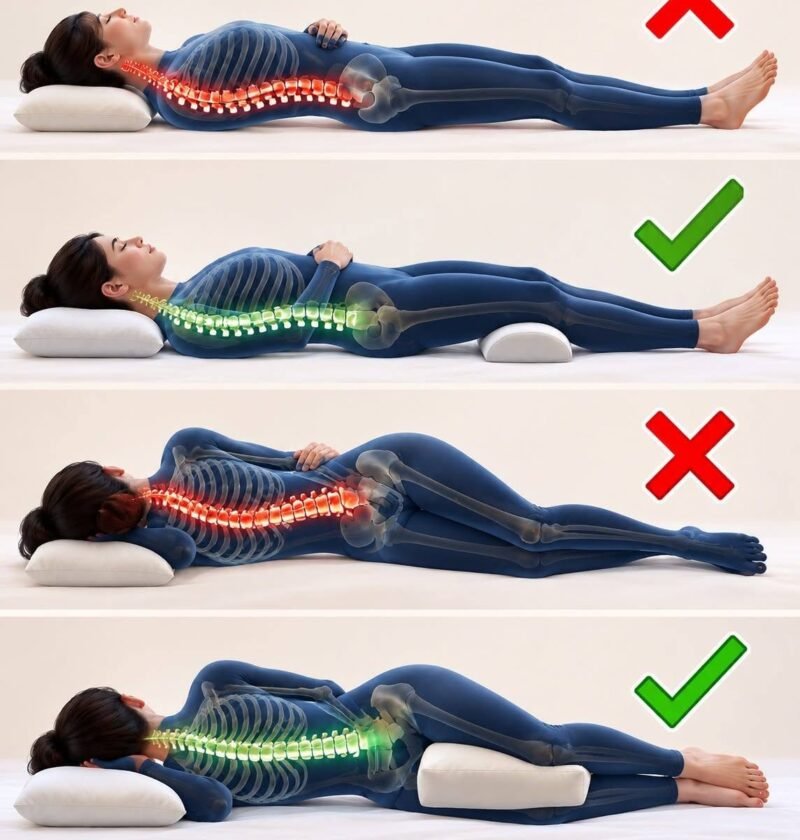
Yes, your sleeping position plays a surprisingly powerful role in your sleep quality, morning comfort, and long-term musculoskeletal health. Because you spend roughly a third of your life in bed, how your body is aligned for seven to eight hours straight directly impacts your spine, airway, digestion, and even how fast your skin develops wrinkles.
Here is how the three primary sleeping positions stack up, along with how to optimize whichever one you prefer.
1. Side Sleeping: The Most Popular (With Pros and Cons)
Over 60% of people sleep on their side. It is fantastic for certain health conditions, but it comes with distinct physical trade-offs.
-
The Benefits: Side sleeping—especially on your left side—is widely considered the gold standard for reducing acid reflux (GERD) because gravity keeps stomach acid below the esophagus. It is also the safest position for preventing snoring and obstructive sleep apnea, and it is the most comfortable position during pregnancy.
-
The Drawbacks: Sleeping on your side puts intense, direct pressure on your shoulder and hip joints, which can trigger bursitis or arm numbness if circulation is compressed. It also compresses one side of your face against the pillow, contributing to facial wrinkles over time.
-
How to Optimize It: Place a firm pillow between your knees to keep your hips and pelvis aligned, preventing your top leg from twisting your lower back.
2. Back Sleeping: Best for Spine Alignment (If You Don’t Snore)
Sleeping flat on your back distributes your body weight evenly across the mattress, making it an orthopedic favorite.
-
The Benefits: Back sleeping keeps your spine, neck, and head in a neutral, stress-free alignment, preventing morning back aches. It also prevents facial wrinkles since your skin isn’t pressed against fabric all night.
-
The Drawbacks: This is the worst position for sleep apnea, snoring, and acid reflux. When you lie on your back, gravity pulls your tongue and soft palate backward, partially blocking your airway. Acid reflux is also much more likely to creep up the esophagus in this position.
-
How to Optimize It: Slide a small pillow or rolled towel underneath your knees. This restores the natural curve of your lower back and relieves lumbar tension. If you snore or have reflux, elevating your head and upper back by 10 to 15 degrees makes a massive difference.
3. Stomach Sleeping: The Least Recommended
Only a small percentage of people sleep on their stomachs, and from a biomechanical standpoint, it is the hardest on your body.
-
The Benefits: It can reduce snoring and mild sleep apnea compared to back sleeping.
-
The Drawbacks: To breathe, you must turn your head completely to one side for hours at a time, twisting your cervical spine and straining the muscles in your neck and upper back. Furthermore, your torso is heavier than your limbs, causing your middle to sink into the mattress, which flattens the natural curve of your spine and strains your lower back.
-
How to Optimize It: If you simply cannot fall asleep any other way, try placing a very thin pillow (or no pillow at all) under your head to reduce neck hyperextension, and slide a flat pillow under your hips/pelvis to support your lower back.
Finding Your Ideal Position
There is no single “perfect” position for everyone; your best posture depends on your health needs. If you wake up stiff, sore, or exhausted, experimenting with targeted support pillows can completely transform how you feel by morning.