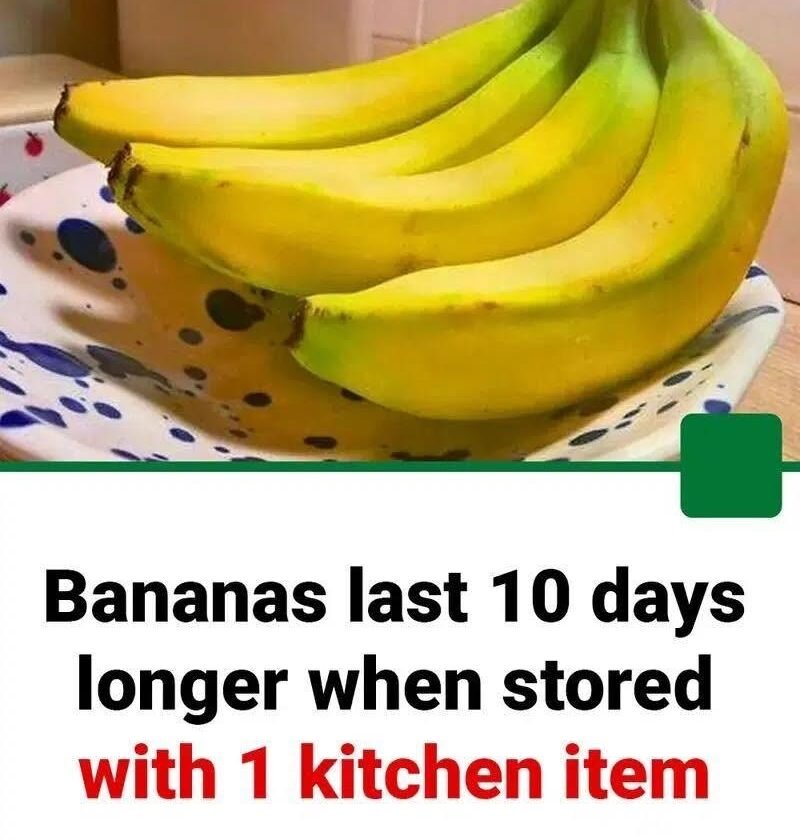
The “10 days longer” claim is too specific to treat as a guarantee. The kitchen item usually being promoted is plastic wrap, used around the banana stems. Evidence suggests stem wrapping may slow ripening somewhat, but other factors—temperature, bruising, and how ripe the bananas are—matter too. (UNL Food)
🍌 How to keep bananas fresh longer
1. Wrap the stems with plastic wrap.
Wrap the crown/stems fairly tightly. The idea is to reduce the release and spread of ethylene, a natural plant hormone involved in ripening. (UNL Food)
2. Keep bananas away from other ripe fruit.
Apples and avocados, for example, also produce ethylene and can accelerate ripening when stored nearby. (UNL Food)
3. Avoid bruising them.
Hanging bananas rather than allowing them to sit under pressure can reduce bruising and help them ripen more evenly. (UNL Food)
4. Refrigerate them once they’re ripe.
The peel may turn brown or black in the refrigerator, but the flesh can remain usable for longer. (UNL Food)
5. Don’t put unripe bananas in the refrigerator.
Cool temperatures can interfere with normal ripening. A cool, dark location is preferable until they’re ripe. (UNL Food)
So, can plastic wrap really add 10 days?
Not reliably. Some tests and food-storage guidance support a modest extension, while other experiments have found little difference from stem wrapping. (Kitchn)
Bottom line: If you want the simplest approach, keep bananas cool, dry, unbruised, separated from other ripe fruit, and refrigerate them once they reach your preferred ripeness. Plastic-wrapping the stems is optional—it may help, but “10 days longer” shouldn’t be considered a guaranteed result.