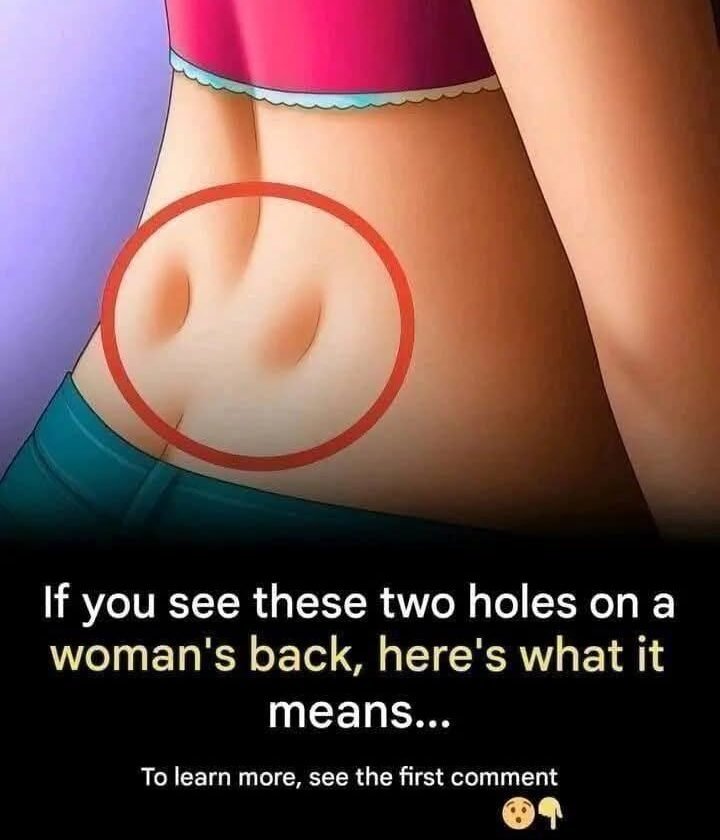
Those two symmetrical indentations located just above the crease of the buttocks—often referred to colloquially as “dimples of Venus” (named after Venus, the Roman goddess of beauty and love) or sacral dimples—spark a lot of curiosity, myths, and internet folklore.
Here is what they actually mean biologically, anatomically, and culturally.
1. The Anatomy: What Are They Really?
From a purely structural standpoint, these dimples are not caused by body fat, lack of fitness, or a mystical health sign. They are purely anatomical landmarks:
-
Pelvic Attachment: They occur where a short ligament firmly attaches the skin directly to the posterior superior iliac spine (the back part of your hip bone).
-
Genetics: Whether you have them or not is entirely determined by your skeletal structure and genetics. If your pelvic bones are shaped a certain way and your connective tissue is tight in that specific spot, the skin is pulled inward, creating the visible indentation. Anyone—regardless of weight or fitness level—can have them if they carry the right genetic bone structure.
2. The Myth of the “Venus Dimples” and Fertility
In historical and cultural lore, these dimples have long been romanticized:
-
Ancient Folklore: They were historically viewed as a marker of physical beauty, youth, and exceptional grace.
-
Fertility and Vitality: In some old European and traditional wellness circles, they were playfully associated with strong vitality or ease in childbirth, simply because they sit over the pelvic girdle. However, there is zero medical or scientific correlation between having lower back dimples and a person’s fertility, hormone levels, or reproductive health.
3. A Quick Distinction: “Venus” Dimples vs. True “Sacral Dimples”
It is important not to confuse cosmetic back dimples with a true sacral dimple:
-
Venus Dimples: Located higher up on the lower back, positioned symmetrically over the hip bones. They are completely harmless and purely structural.
-
Sacral Dimples: Located lower down, right in the crease directly above the tailbone (coccyx). While most sacral dimples are harmless birthmarks or harmless indentations, doctors check newborns for them because a deep sacral dimple—especially if accompanied by a tuft of hair or discoloration—can occasionally indicate an underlying spinal cord issue (like spina bifida occulta).
If you have those two symmetrical indentations on your lower back, they are simply a normal, genetically inherited physical trait—and a unique part of human skeletal anatomy!