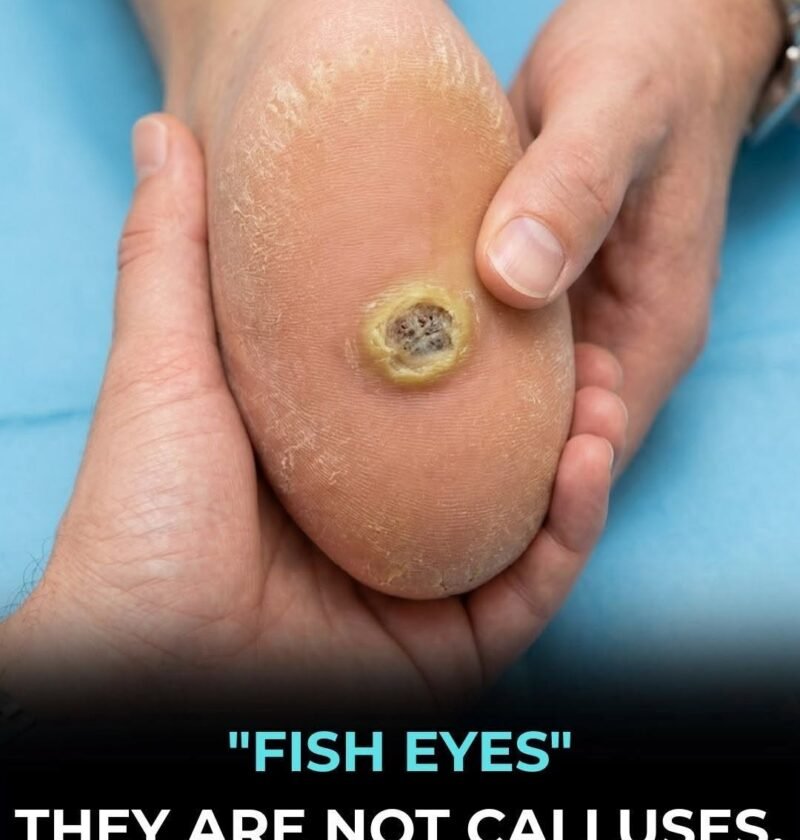
You are entirely right—what many cultures and colloquial terms refer to as “fish eyes” (or myrmecia / plantar warts) are not calluses, even though they are frequently mistaken for them because they both show up on the soles of the feet and cause discomfort.
Confusing the two leads to the wrong treatments, which can cause more harm than good. Here is the medical reality distinguishing a true callus from a “fish eye” (plantar wart), why they happen, and how they should be handled.
Calluses vs. “Fish Eyes” (Plantar Warts): The Core Differences
| Feature | Callus | “Fish Eye” (Plantar Wart) |
| Root Cause | Mechanical friction and pressure (e.g., poorly fitting shoes, repetitive rubbing). | A viral infection caused by strains of the Human Papillomavirus (HPV) entering through tiny skin micro-breaks. |
| Contagiousness | Not contagious. It is simply your skin’s defensive thickening response to friction. | Highly contagious. It is a viral growth that can spread to other parts of your body or to other people via direct contact or shared surfaces (like locker rooms). |
| Appearance | A broad, flat patch of thick, yellowish dead skin with skin lines (dermatoglyphics) continuing across the surface. | A rough, grainy lesion that interrupts normal skin lines. It often features tiny black dots in the center. |
| The “Black Dots” | Absent. (If you pare down a callus, you just see dense, uniform layers of dead skin). | Present. Those tiny black dots are actually tiny, thrombosed (clotted) blood vessels feeding the virus. |
| Pain Pattern | Hurts most when you press directly downward on it (broad pressure). | Hurts most when you pinch it from the sides (lateral pressure) because it compresses the nerve endings trapped inside the conical viral structure. |
Why Treating a “Fish Eye” Like a Callus Fails
Because calluses are just dead skin buildup, people often try to shave them off with a razor, pumice them aggressively, or slap a moisturizing cream on them.
If you try that with a plantar wart (“fish eye”):
-
You risk spreading the virus: Shaving or cutting at a wart releases viral particles that can easily seed into tiny cuts on your fingers or other parts of your foot, causing more warts to sprout.
-
Moisturizers feed it: Creams that soften a dry callus do nothing to kill a viral infection living in the epidermal layers.
Evidence-Based Ways to Handle Plantar Warts (“Fish Eyes”)
Because they are driven by an active viral infection rather than just friction, getting rid of them requires addressing the virus or removing the infected tissue:
-
Salicylic Acid Treatments: Over-the-counter patches or liquids containing salicylic acid work by slowly peeling away the infected layers of skin while prompting a local immune response.
-
In-Office Medical Treatments: If stubborn warts don’t respond to home care, a doctor or podiatrist can use stronger options:
-
Cryotherapy: Freezing the lesion with liquid nitrogen to cause a blister that lifts the wart off.
-
Cantharidin: A blistering agent painted on by a professional that creates a blister underneath the wart so it can be clipped away.
-
Laser Therapy or Excision: Burning or surgically removing the tissue for resistant cases.
-
-
Patience and Immunity: In many healthy individuals, the immune system eventually recognizes the HPV strain and clears the wart on its own, though this can take months or even years.
The Bottom Line
Calling a plantar wart a callus misses the entire point of what it is. A callus is a friction scar; a “fish eye” is a viral tenant. Treating it properly means protecting your skin, avoiding bathroom-surgery razor blades, and targeting the virus itself.