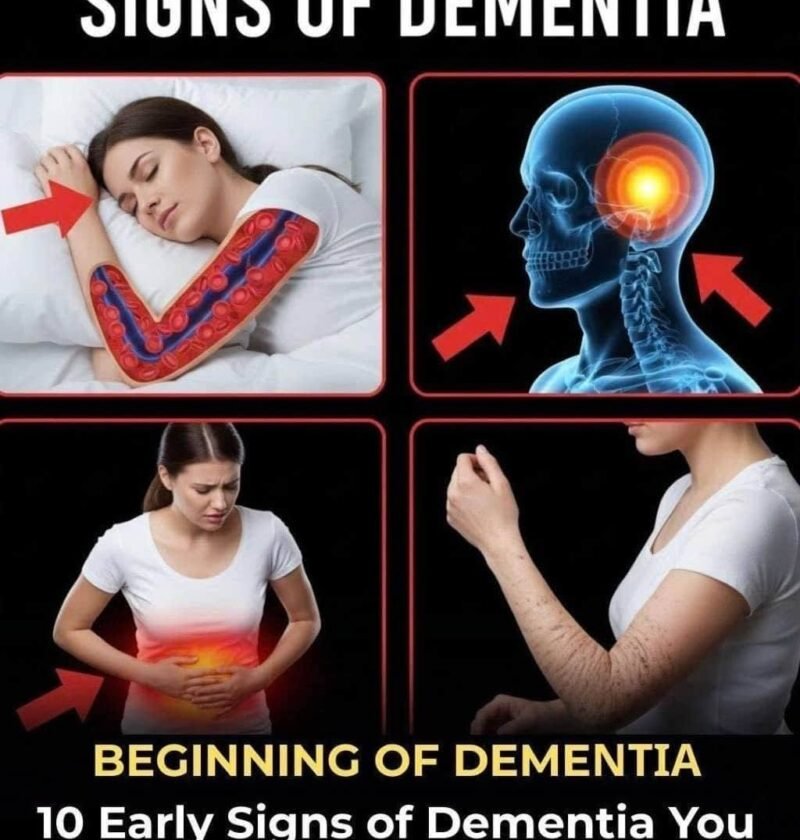
🧠 10 Early Signs of Dementia You Shouldn’t Ignore
The headline is attention-grabbing, but the symptoms are worth knowing. One symptom does not mean someone has dementia. Dementia is diagnosed when cognitive problems become significant enough to interfere with everyday life, and several other medical conditions can cause similar symptoms.
N
National Institute on Aging
+1
Memory loss that disrupts daily life — repeatedly forgetting recently learned information, conversations, or important appointments.
Difficulty planning or solving problems — trouble managing bills, following a familiar recipe, or handling numbers.
Difficulty completing familiar tasks — struggling with activities that were previously routine.
Confusion about time or place — losing track of dates, seasons, or where they are.
Problems with visual or spatial information — difficulty judging distances, reading, or navigating familiar places.
New difficulty speaking or writing — frequently struggling to find familiar words or follow a conversation.
Frequently misplacing things and being unable to retrace steps — putting objects in unusual places and being unable to work backward to find them.
Poorer judgment — unusual financial decisions, neglecting personal care, or other significant changes in decision-making.
Withdrawal from hobbies or social activities — losing interest in activities they previously enjoyed.
Changes in mood or personality — becoming unusually anxious, suspicious, fearful, depressed, confused, or irritable.
A
Alzheimer’s Association
🧓 What’s normal aging?
Occasionally forgetting a name or appointment and remembering it later can happen with normal aging. More concerning is a persistent decline that interferes with everyday activities—for example, repeatedly struggling to manage bills or becoming unable to navigate a familiar location.
N
National Institute on Aging
🩺 When to get checked
If you notice progressive changes in memory, thinking, language, judgment, personality, or ability to perform everyday tasks, arrange an evaluation with a healthcare professional. Early assessment can help identify the cause and, when appropriate, provide access to treatment and support.
A
Alzheimer’s Association
Important: Sudden confusion is different from slowly developing dementia. If confusion or other neurological symptoms appear suddenly—particularly facial drooping, one-sided weakness, difficulty speaking, or sudden vision problems—seek emergency care because this can indicate a stroke.
N
A
Sources