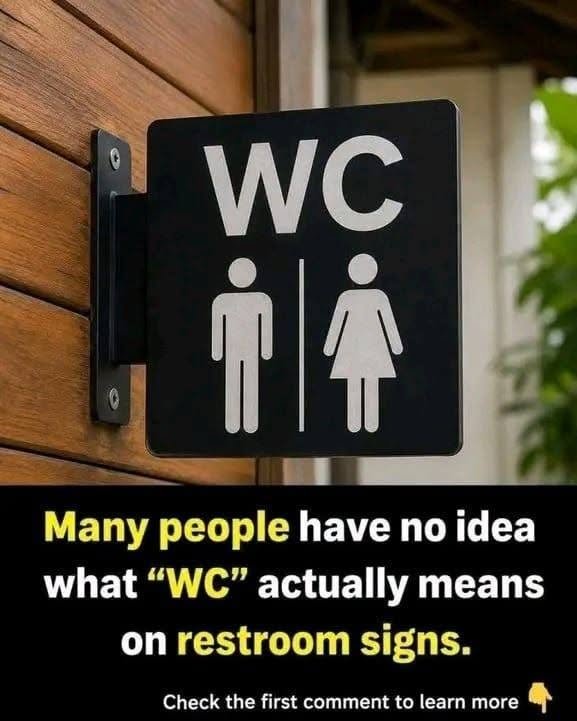
Viral trivia posts love to frame simple historical abbreviations as baffling, long-lost mysteries waiting to be “solved.” When you travel internationally, encounter older architecture, or look at European signage, seeing the letters “WC” stamped on a door is common, but its meaning is straightforward.
“WC” stands for Water Closet.
The History Behind the Term
-
Why “Water”? Back in the late 19th century—when indoor plumbing was a brand-new, miraculous invention—homes and public buildings needed a way to distinguish the new flushable indoor toilets from the old outdoor outhouses, earth closets, and chamber pots. Adding “water” highlighted that the fixture was connected to running pressurized water to wash waste away.
-
Why “Closet”? In Victorian times, the word “closet” didn’t just mean a wardrobe for clothes; it referred to any small, private, enclosed room or partitioned compartment. Thus, a “water closet” was literally a small, private room housing a plumbed, flushing toilet.
How the Term Spread
While Americans largely shifted to calling the room a “bathroom,” “restroom,” or “toilet” during the 20th century, the term WC stuck firmly across Europe, parts of Asia, and international travel hubs. Because abbreviations transcend language barriers, seeing “WC” on an airport or train station map became a universally understood symbol for travelers worldwide.
Have you encountered “WC” signs while traveling abroad, or were you tracking down the history of other everyday architectural abbreviations?