Small White Spots on the Arms and Legs: What They Can Mean
Small white spots are fairly common and usually aren’t an emergency, but their appearance, distribution, and whether they’re changing can help identify the cause.
Common possibilities include:
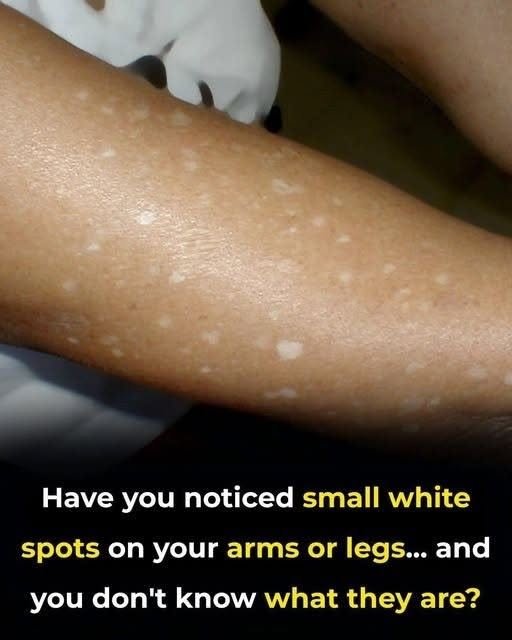
Idiopathic guttate hypomelanosis (IGH): Small, flat, pale or white spots—often on the forearms and lower legs—that become more common with age and sun exposure.
Sun-related changes: Repeated UV exposure can cause uneven pigmentation.
Tinea versicolor: A superficial fungal infection that can produce lighter or darker patches, sometimes with fine scaling.
Post-inflammatory hypopigmentation: Skin can temporarily lose some pigment after an injury, rash, or inflammation.
Vitiligo: Smooth, clearly lighter patches caused by loss of pigment-producing cells; patches can gradually enlarge or appear elsewhere.
When to have them checked
See a dermatologist or healthcare professional if the spots are rapidly spreading, becoming completely depigmented, itchy or scaly, painful, bleeding, or accompanied by other skin changes. A new pattern of widespread pigment loss also deserves evaluation.
Don’t assume that white spots mean a vitamin deficiency or automatically indicate a serious internal disease. A clinician can often distinguish the common causes simply by examining the skin.
If you describe what the spots look like (size, shape, flat/raised, scaly or smooth), where they are, and how long you’ve had them, I can help narrow down the possibilities.