…clickbait health and wellness headlines love to use breathless, alarmist hooks like “Sleeping on your right side: The hidden biological disaster slowly destroying your organs every night!” to make you paranoid about every natural position you shift into while drifting off to sleep.
While sleep posture can influence certain physical symptoms—particularly for people with specific chronic conditions—the unvarnished medical reality is much more grounded: your body naturally shifts and moves multiple times throughout the night, and there is no single “perfect” sleeping position that applies to everyone.
While internet articles love to demonize right-side sleeping, let’s separate the viral exaggeration from the actual physiological science of how your body responds to sleep posture.
What Science Actually Says About Right-Side Sleeping
When sleep researchers study sleep posture, they look at how gravity and body weight interact with internal organs. Here is what is happening physiologically when you sleep on your right side:
1. Impact on Acid Reflux (GERD)
-
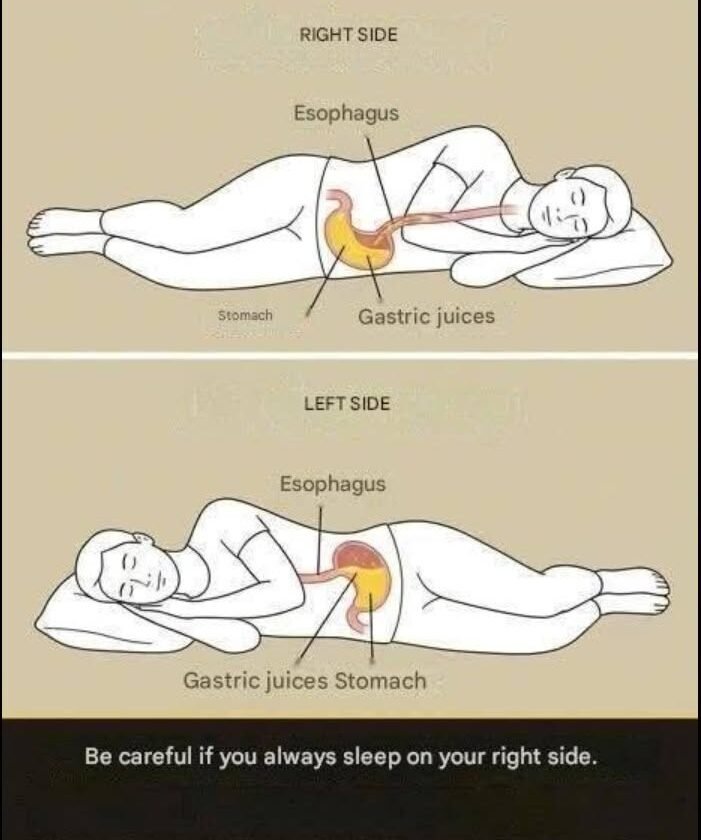
The science: This is the most clinically validated aspect of sleep posture. The stomach sits on the left side of the upper abdomen. When you sleep on your left side, the gastric junction sits above the level of gastric acid, making it harder for stomach acid to escape into the esophagus. When you sleep on your right side, the stomach sits higher than the esophagus, which can relax the lower esophageal sphincter and make acid reflux or heartburn flare up for people prone to GERD.
-
The reality: If you don’t suffer from chronic acid reflux or GERD, sleeping on your right side will not magically give it to you.
2. Impact on Cardiovascular Health and Pregnancy
-
The science: During late-stage pregnancy, doctors often recommend sleeping on the left side to prevent the heavy uterus from pressing on the inferior vena cava—the large vein returning blood to the heart—which can reduce cardiac output and cause dizziness. Similarly, some cardiac studies suggest sleeping on the left side feels more comfortable for people with certain heart failure conditions because the heart is less restricted by surrounding chest structures.
-
The reality: For healthy individuals, the heart and major blood vessels tolerate right-side sleeping just fine without adverse effects.
3. Spinal Alignment and Musculoskeletal Comfort
-
The science: The primary factor determining whether a sleep position is “good” or “bad” for you isn’t organ placement—it’s spinal alignment. Whether you sleep on your right side, left side, or back, what matters most is whether your neck, spine, and hips are supported in a neutral position without twisting or straining joints.
The Bottom Line
You do not need to stress out or tie yourself into knots trying to control how you lie in bed. If you wake up comfortable, rested, and free of heartburn or joint pain, whatever position your body naturally drifted into is working just fine.