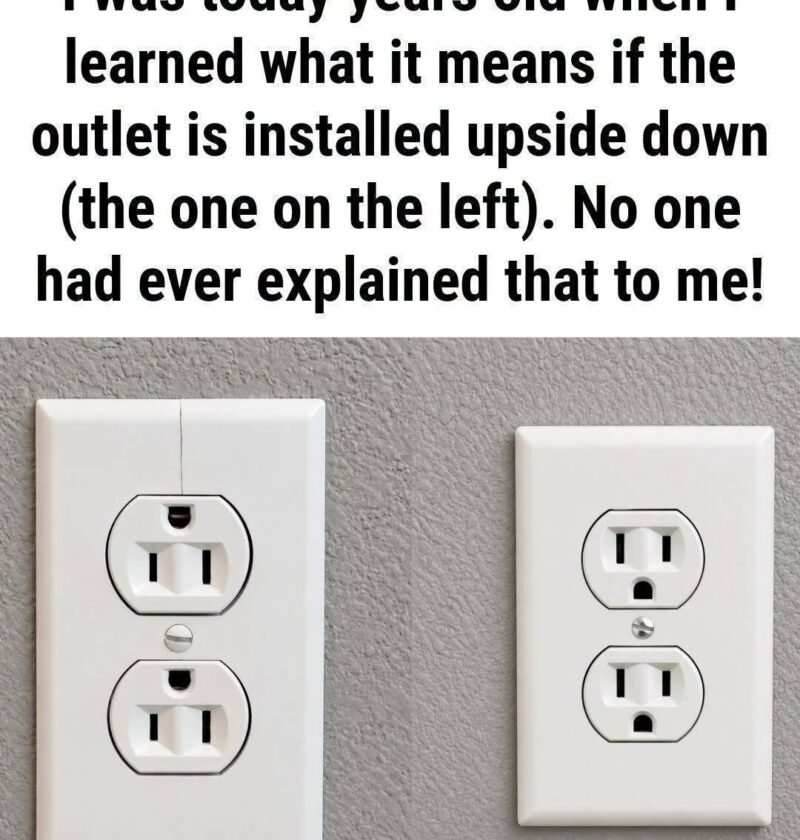
“No One Had Ever Explained That to Me!” Why Some Electrical Outlets Are Installed Upside Down
Have you ever noticed an electrical outlet installed with the grounding hole on top instead of the bottom?
It may look like someone installed it incorrectly—but in some situations, there is a practical reason for this orientation.
⚡ The Ground Pin Can Be Positioned on Top for Safety
In a typical North American outlet, the grounding opening is often installed below the two power slots.
But some electricians install the receptacle with the grounding slot on top.
One reason is what could happen if a metal object accidentally falls onto a partially inserted plug.
With the ground pin on top, the idea is that the object is more likely to contact the grounding pin or the grounded portion of the plug first, rather than bridging the two energized contacts.
This can potentially reduce the risk of a short circuit in certain situations.
🔌 Is an Upside-Down Outlet Safer?
Not necessarily.
There is no universal rule that says a receptacle must have the ground opening on top or bottom. Electrical codes and local practices vary, and both orientations can be found in properly installed electrical systems.
The more important safety features are proper wiring, grounding, circuit protection, and using the correct receptacle for the application.
🏥 Why Do You Sometimes See Them in Hospitals?
You may notice ground-up receptacles in hospitals and other commercial settings.
In some installations, the orientation can be chosen for practical or safety reasons, particularly where plugs and cords are frequently used or where equipment has special requirements.
But the orientation itself isn’t what makes a receptacle a medical-grade or safer installation.
🧰 Should You Turn Yours Around?
Don’t do it just because you saw a viral post.
If an outlet is loose, damaged, warm, sparking, buzzing, or showing signs of discoloration, stop using it and have it inspected by a qualified electrician.
And never open an electrical receptacle unless you know how to safely de-energize and verify the circuit.