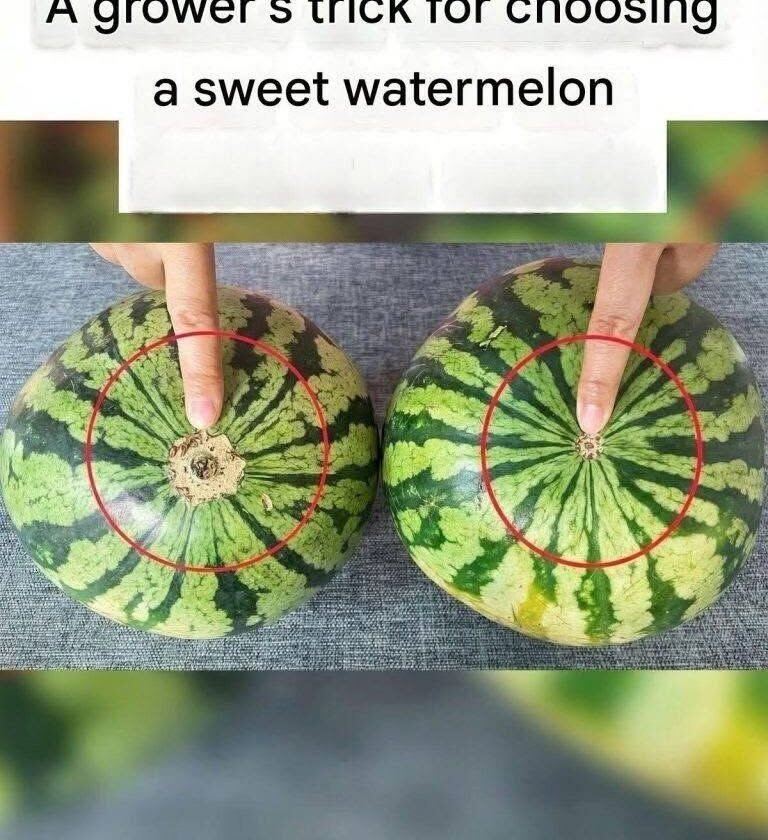
How to Pick a Sweeter, Riper Watermelon
There’s no 100% foolproof visual test for sweetness, because sweetness ultimately depends on the variety and growing conditions. But several external clues can improve your chances of choosing a ripe, flavorful watermelon.
-
Look for a large creamy-yellow field spot — This is the area that rested on the ground. A yellow or golden spot generally indicates the melon had time to ripen, while a very white spot may indicate it was harvested earlier.
-
Choose a duller-looking rind — A ripe watermelon often loses some of its shiny appearance. A very glossy rind isn’t necessarily a bad sign, but dullness can be a useful ripeness clue.
-
Look for strong, well-defined stripes — Clear contrast between the dark and light stripes can accompany a mature melon, although stripe patterns vary by variety.
-
Check the stem if it’s visible — A dried, brownish stem can indicate maturity. A very green stem may mean the fruit was harvested relatively recently, though this isn’t a reliable sweetness test by itself.
-
Pick one that feels heavy for its size — A heavier watermelon generally contains plenty of water and is often a good sign of freshness.
-
Look for a well-developed, symmetrical shape — Avoid melons with major dents, soft areas, cuts, or unusual deformities that could indicate damage or poor development.
-
Don’t rely solely on the “knock test” — A deep, resonant sound is often described as a sign of ripeness, but it’s subjective and much less dependable than examining several clues together.
The best strategy
Use several signs together: a large creamy-yellow field spot + good weight for its size + an intact, symmetrical rind is a more useful combination than any single “secret” trick.
And remember: you can’t reliably determine sweetness from appearance alone. If the market allows samples, tasting is the most direct way to judge flavor.