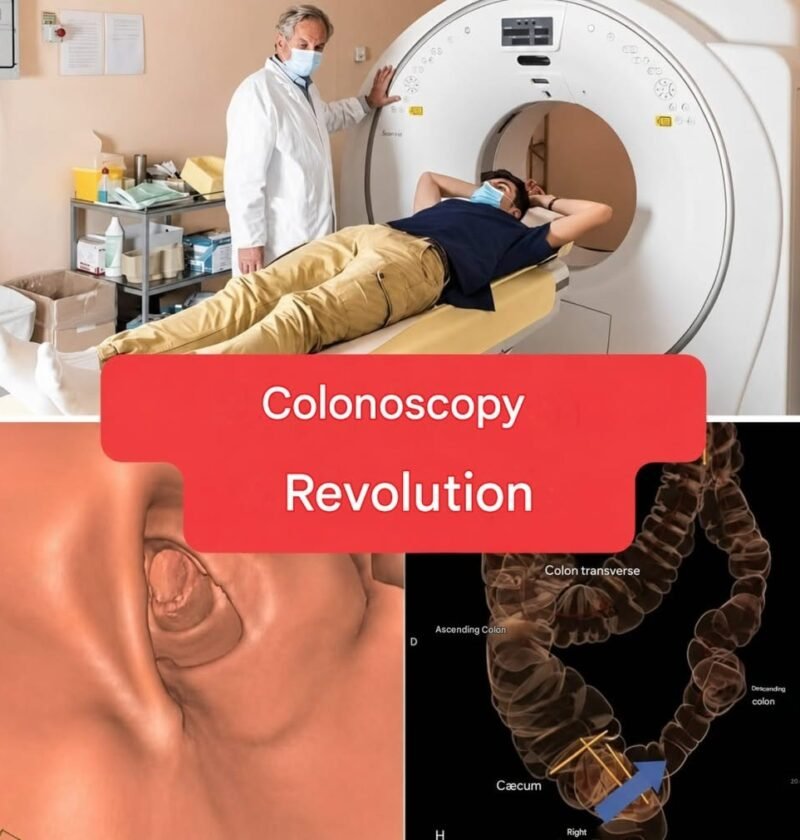
This headline is partly based on real developments, but it exaggerates them. Colonoscopy has not been replaced by a completely non-invasive test.
There are already alternatives that are less invasive:
1. 🖥️ CT colonography (“virtual colonoscopy”)
A CT scanner creates images of the colon and rectum. It doesn’t require a long camera to be passed through the colon and usually doesn’t require sedation. However, a small tube is still placed in the rectum, the colon must be inflated with air or gas, and bowel preparation is still required.
If a significant polyp or suspicious lesion is found, you’ll generally still need a conventional colonoscopy to remove it or take a biopsy.
2. 💊 Colon capsule
A person swallows a pill-sized camera that travels through the digestive tract and takes pictures. This is a promising technology, but it hasn’t replaced conventional colonoscopy for routine screening. Current guidance describes capsule colonoscopy as an option in selected circumstances rather than a universal replacement.
And, importantly, bowel cleansing is still necessary for capsule examination.
3. 🧪 Stool tests
FIT and stool-DNA tests are genuinely non-invasive and can be done at home. They’re useful colorectal-cancer screening options, but they don’t directly examine the entire colon or remove polyps. An abnormal result generally requires a colonoscopy.
So has colonoscopy become obsolete?
No. Colonoscopy remains particularly valuable because doctors can see the colon directly and remove precancerous polyps during the same procedure. That’s something CT scans, stool tests and most emerging non-invasive tests cannot do.
Bottom line: The “new method” is probably referring to virtual colonoscopy, capsule colonoscopy, or another emerging screening technology. These can reduce invasiveness for certain patients, but there is currently no universal replacement that makes conventional colonoscopy unnecessary.
If you have the second half of this headline (2/2), send it to me—I can identify exactly which “new method” the post is referring to and whether its claims are legitimate.