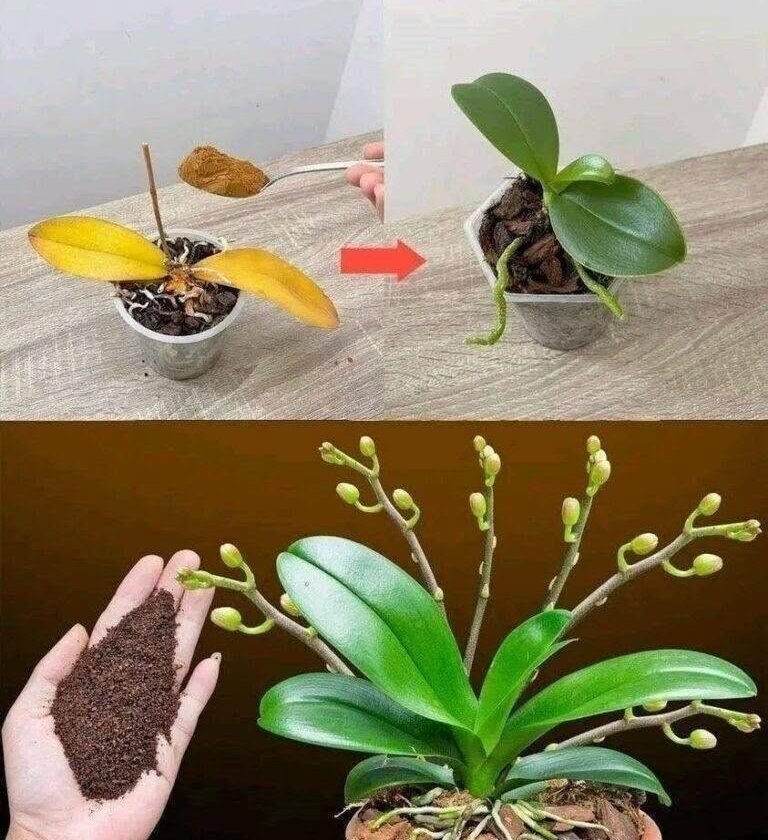
🌸 “Just 1 Teaspoon and Your Orchid Will Bloom Like Crazy” — What Really Works
There is no magic one-teaspoon ingredient that will suddenly make an orchid produce lots of flowers. Viral recipes using sugar, baking soda, rice water, coffee, or other kitchen ingredients can sometimes do more harm than good.
For orchids, light is usually much more important than fertilizer. The American Orchid Society notes that insufficient light is one of the most common reasons orchids fail to rebloom. (American Ornithological Society)
🌱 If you want more blooms
1. Give it adequate light
For a typical Phalaenopsis, a bright east-facing window is excellent; shaded south or west exposure can also work. Avoid harsh direct midday sun that can scorch the leaves. (American Ornithological Society)
2. Use proper orchid fertilizer
Rather than an unidentified kitchen ingredient, use a complete orchid fertilizer at a dilute concentration. The American Orchid Society recommends weak, regular feeding rather than heavy doses, because excessive fertilizer can lead to salt buildup and root damage. (American Ornithological Society)
3. Don’t overwater
Water thoroughly, then allow the potting medium to become nearly dry before watering again. Avoid leaving water sitting in the crown of the plant because this can encourage crown rot. (American Ornithological Society)
4. Give it an appropriate temperature change
For Phalaenopsis, several weeks of cooler nighttime temperatures around 55°F (13°C) in autumn can help initiate flower spikes. (American Ornithological Society)
🥄 So what about “one teaspoon”?
If the recipe means one teaspoon of commercial orchid fertilizer, don’t use that amount blindly. Fertilizer strength varies considerably between products. Follow the product’s dilution instructions rather than measuring by teaspoon alone.
Bottom line: There is no miracle tablespoon or teaspoon that guarantees nonstop blooms. Good light + appropriate watering + weak, properly formulated fertilizer + suitable temperatures give an orchid a much better chance of producing abundant flowers. (American Ornithological Society)