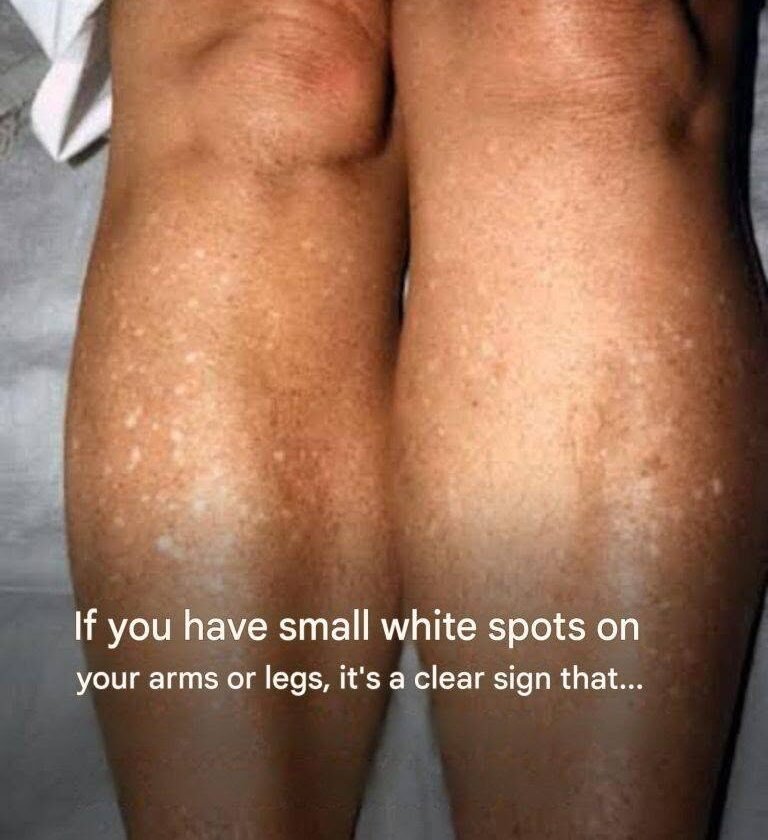
When a headline cuts off with “If you have small white spots on your arms or legs, it’s a clear sign that…” and invites you to click “See more,” it is almost always setting up a single, dramatic answer—like a hidden vitamin deficiency, liver trouble, parasites, or an urgent warning sign.
In dermatology, small white spots on the arms or legs are rarely a “clear sign” of one single thing. Because arms and legs get heavy sun exposure, friction, and sweat, tiny pale or white spots on them usually point to a few very common, localized skin patterns rather than a hidden alarm bell.
What Small White Spots on Arms and Legs Usually Point To
-
Sun & Aging Spots (Idiopathic Guttate Hypomelanosis):
-
What they look like: Tiny, flat, porcelain-white or light spots (often a few millimeters across), very common on the shins and forearms.
-
What they mean: Long-term cumulative UV exposure and normal skin aging gradually reduce pigment in small scattered spots. They are harmless and do not require treatment.
-
-
Post-Inflammatory Hypopigmentation:
-
What they look like: Pale spots left behind where the skin was previously irritated, scratched, burned, or inflamed.
-
What they mean: After minor eczema flares, bug bites, friction, or healing rashes, melanin production can temporarily lag in that spot while the skin recovers.
-
-
Mild Eczema / Dry Patches (Such as Pityriasis Alba):
-
What they look like: Slightly lighter, dry, or subtly scaly patches that often look more obvious after sun exposure or in dry weather.
-
What they mean: Mild skin barrier dryness or low-grade inflammation reduces normal surface contrast, often improving with consistent moisturizing and gentle skin care.
-
-
Superficial Yeast Overgrowth (Tinea Versicolor):
-
What they look like: Small or merging light (or sometimes tan/pink) patches that may show fine scaling.
-
What they mean: Overgrowth of normal skin yeast (Malassezia)—often encouraged by warmth, humidity, or sweat—can temporarily affect pigment tone and typically responds well to targeted antifungal care.
-
-
Vitiligo (Less Common Than Viral Posts Suggest):
-
What they look like: Smooth, sharply defined milk-white patches where pigment-producing cells (melanocytes) are lost.
-
What they mean: An autoimmune condition rather than a diet deficiency or simple surface dryness; patches can stay stable or expand over time.
-
Why “See More” Posts Oversimplify This
-
No Single-Cause Shortcut: Two people can have tiny white spots on their forearms for completely different reasons—one from years of sun exposure on the shins, another from mild dryness or a recent minor rash.
-
Diet Myths Rarely Explain Tiny Spots: Isolated small white spots on the limbs are not a reliable stand-alone marker of a specific vitamin deficiency, and buying supplements blindly rarely changes them.
-
Context Matters: Where the spots are, how long they have been there, whether they are flat or scaly, itchy, spreading, or appearing alongside other symptoms all change what a clinician looks for.
When to Get Them Checked
If the spots are spreading, changing in size or texture, itching or scaling, or if you simply want peace of mind about whether they are harmless sun spots, mild dryness, or something needing targeted treatment, having a doctor or dermatologist take a direct look gives a much clearer answer than any clickbait ending.