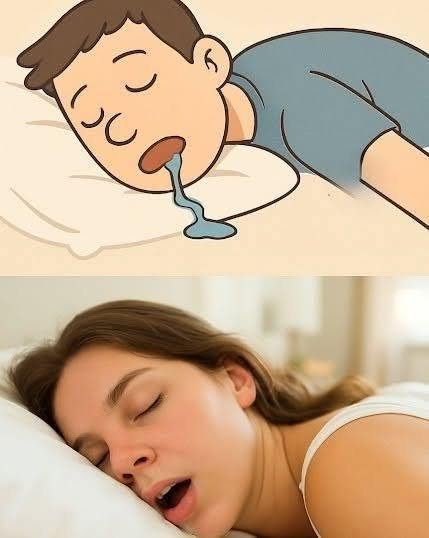
Ah, the ultimate internet diagnostic leap! Take a completely normal, harmless physiological quirk—drooling on your pillow—and instantly link it to six terrifying neurological disorders.
While chronic or excessive drooling can occasionally be a clue to an underlying medical issue, the vast majority of the time, it simply comes down to physics, gravity, and how you happen to be positioned when your muscles completely relax at night.
Here is why you drool in your sleep, what those articles are usually freaking out about, and what it actually means:
Why Most People Drool While Sleeping (It’s Normal!)
When you drift off into deep or REM sleep, your body relaxes completely. This includes your jaw muscles, your lips, and your swallowing reflex.
-
Sleeping Position: If you sleep on your side or your stomach, gravity naturally pulls your mouth open slightly, and saliva pools and escapes onto your pillow.
-
Nasal Congestion: If you have a stuffy nose, allergies, a deviated septum, or sleep apnea that forces you to breathe through your mouth all night, your mouth stays open, and your salivary glands keep producing saliva while you sleep. The result? A wet spot on the pillow.
What the Clickbait Articles Claim (The 6 “Diseases”)
When these sensationalist articles list six scary conditions, they are usually pulling from medical textbooks on sialorrhea (medical-grade excessive drooling). The conditions they typically sensationalize include:
-
Neurological Disorders (like Parkinson’s Disease or ALS): These conditions can impair the body’s automatic swallowing reflex or affect facial muscle control, causing saliva to pool and spill out. However, drooling in these cases is accompanied by major, unmistakable symptoms like severe tremors, muscle stiffness, balance issues, or profound weakness—not just a wet pillow.
-
Stroke: A stroke can cause temporary or permanent facial drooping and weakness in the mouth or throat muscles. Again, this comes with sudden, dramatic neurological signs (like slurred speech, facial asymmetry, or arm weakness), not just a random Tuesday morning of drooling.
-
Bell’s Palsy: This causes temporary weakness or paralysis of the muscles on one side of the face. Because one side of the mouth may not close tightly, saliva can escape, but it is accompanied by obvious facial drooping.
-
Obstructive Sleep Apnea (OSA): While sleep apnea forces mouth-breathing (which does lead to drooling), it is primarily characterized by loud snoring, gasping, waking up choking, and severe daytime fatigue—not just drooling alone.
-
Gastroesophageal Reflux Disease (GERD): Some studies suggest that acid irritation in the esophagus can trigger the salivary glands to produce extra saliva to help neutralize the acid. While you might swallow more during the day, at night, that extra saliva can escape.
-
Side Effects from Medications: Certain psychiatric drugs, sedatives, or medications for Alzheimer’s can stimulate excess saliva production as a side effect.
🚨 The Real Takeaway
Unless your nighttime drooling is a brand-new habit accompanied by other neurological symptoms (like trouble swallowing food during the day, slurred speech, or unexplained stiffness), it is almost certainly just a harmless byproduct of sleeping on your side or breathing through your mouth due to a stuffy nose.
Did this article try to convince you that a bit of morning pillow-dampness is an early warning sign of a stroke or Parkinson’s, or did they try to sell you a specialized anti-drool pillow harness?