Common Causes of Hard Lumps on Finger Joints
-
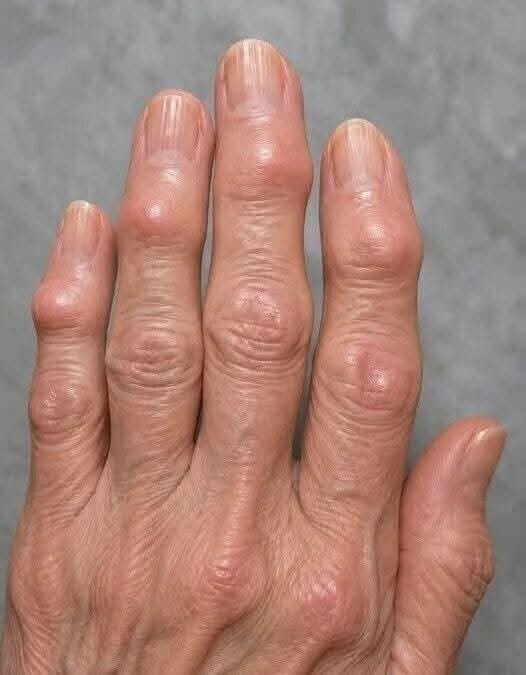
Osteoarthritis (Heberden’s and Bouchard’s Nodes): The most frequent cause, especially in adults over 40. As joint cartilage wears down, the body forms extra bone spurs at the joint edges.
-
Heberden’s nodes form on the distal interphalangeal (DIP) joints—the joints closest to the fingernails.
-
Bouchard’s nodes form on the proximal interphalangeal (PIP) joints—the middle joints of the fingers.
-
They feel hard and bony, develop slowly over months or years, and may ache or feel stiff early on before becoming painless.
-
-
Mucous Cysts (Digital Ganglion Cysts): Small, firm, fluid-filled sacs that typically appear near the last joint of a finger, close to the base of the fingernail. Although filled with thick joint fluid, high internal pressure can make them feel very hard. They often occur alongside osteoarthritis and can sometimes cause a longitudinal groove in the fingernail.
-
Rheumatoid Nodules: Firm lumps under the skin that develop in some people with rheumatoid arthritis. They tend to appear over pressure points, including the middle finger joints and knuckles, and are usually accompanied by symmetrical joint pain, swelling, and morning stiffness lasting more than 30–60 minutes.
-
Gouty Tophi: Chalky, firm deposits of uric acid crystals that build up around joints in people with longstanding, untreated gout. Tophi can look white or yellowish beneath thin skin and may occasionally drain a chalky substance.
-
Giant Cell Tumor of the Tendon Sheath: A benign, slow-growing, firm soft-tissue nodule attached to a tendon sheath in the finger or hand. It is usually painless and feels distinct from the bone itself.
How Different Finger Joint Lumps Compare
| Cause | Typical Location | Feel & Appearance | Common Accompanying Signs |
| Heberden’s / Bouchard’s Nodes | End joints (DIP) or middle joints (PIP) | Hard, bony, immovable | Mild stiffness, joint widening, family history |
| Mucous Cyst | Top of end joint near fingernail | Very firm or slightly rubbery; smooth dome | Nail ridging/grooving; size may fluctuate |
| Rheumatoid Nodules | Middle joints (PIP), knuckles, elbows | Firm, rounded, under the skin | Symmetrical warm swollen joints, morning stiffness |
| Gouty Tophi | Any finger joint, often irregular | Hard, lumpy; sometimes whitish-yellow tint | History of painful gout flares, high uric acid |
| Tendon Sheath Tumor | Along finger tendons (palm or side) | Firm, painless, slow-growing nodule | Usually isolated to one finger; normal joint surface |
When to Have a Doctor Evaluate Them
-
Do not squeeze or puncture a lump at home: If a bump is a mucous cyst, puncturing it creates a direct pathway for bacteria to enter the underlying finger joint, risking a serious joint infection.
-
Seek prompt medical care if you notice:
-
Redness, warmth, throbbing pain, or pus draining from the lump
-
Rapid growth over days or weeks
-
Numbness, tingling, or loss of ability to bend or straighten the finger
-
Multiple painful, swollen joints across both hands
-