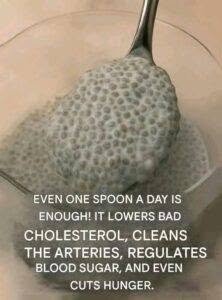
That sentence is making four separate health claims, and they need different levels of evidence:
-
“One spoonful a day is enough” — This is generally an overstatement. The appropriate amount depends entirely on what the food or substance is, its nutritional composition, and the person’s overall diet and health. There usually isn’t a universal “one spoonful” dose that produces all these effects.
-
“It lowers bad cholesterol” — Some foods can help reduce LDL (“bad”) cholesterol, particularly when they contain soluble fiber or when unsaturated fats replace saturated fats in the diet. But the effect depends on the specific food and the overall dietary pattern. A single daily serving isn’t necessarily enough to produce a clinically meaningful reduction.
-
“It cleans arteries” — This is misleading. There isn’t a food that literally cleans or scrubs plaque out of arteries. Some dietary patterns can reduce LDL cholesterol and cardiovascular risk, which may help slow the development of atherosclerosis, but that’s very different from physically clearing blocked arteries.
-
“It regulates blood sugar” — Certain high-fiber foods, nuts, seeds, and other foods can have beneficial effects on post-meal blood-glucose responses. However, the effect varies considerably, and no ordinary food should be presented as a substitute for diabetes treatment or glucose monitoring when those are medically indicated.
-
“It suppresses hunger” — Protein, fiber, and some types of fat can increase satiety, so particular foods may make someone feel fuller. But “suppresses hunger” suggests a reliable appetite-control effect that can’t be assumed from one spoonful.
A more scientifically accurate version
“Adding a small serving of certain nutrient-rich foods to your daily diet may help support healthier cholesterol levels, blood-sugar control, and feelings of fullness. However, no single spoonful can literally clean your arteries, and its benefits depend on the specific food and your overall diet.”
If you tell me what the “one spoonful” is supposed to be, I can break down exactly what the research says about its effects on LDL cholesterol, arterial plaque, blood sugar, appetite, dosage, and possible side effects.