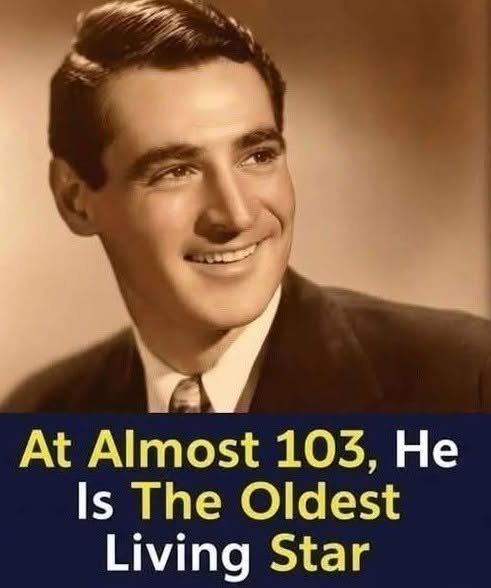
When reflecting on the giants of Hollywood’s Golden Age who crossed the extraordinary threshold of 103, legends like the indomitable Kirk Douglas instantly come to mind. Passing away at the age of 103 in 2020, Douglas lived a life that mirrored the very history of modern cinema, transitioning from an impoverished immigrant childhood to becoming one of the most fierce, magnetic screen icons the world has ever known.
From “Izzy Demsky” to Hollywood Royalty
Born Issur Danielovitch to illiterate Jewish-Russian immigrant parents in Amsterdam, New York, his beginnings were defined by intense poverty and hardship. Growing up as the only boy among six sisters, he worked dozens of odd jobs—from selling snacks to delivery work—just to help his family survive.
-
The Athletic Spark: Before he found acting, wrestling was his ticket out. He wrestled competitively through college at St. Lawrence University, discovering that physical discipline and grit could take him places.
-
The Stage and WWII: He changed his name to Kirk Douglas before hitchhiking to New York City to attend the American Academy of Dramatic Arts on a scholarship. His momentum was briefly interrupted by World War II, where he served as a communications officer in the U.S. Navy aboard an anti-submarine ship until being medically discharged in 1944 due to injuries.
Breaking the Mold: The Birth of a Tough Guy
Thanks to a recommendation from his friend Lauren Bacall, Douglas landed his first film role in The Strange Love of Martha Ivers (1946). But it was his star-making turn as an unyielding, ruthless boxer in Champion (1949) that cemented his archetype: he specialized in playing fiercely intense, morally complex, and fiercely independent men.
Unlike the polished, smooth leading men of early Hollywood, Douglas brought a raw, dangerous edge to the screen. He famously said, “I’ve made a career of playing sons of bitches.” Yet audiences loved him for his unvarnished intensity.
Defining a Century of Cinema
Over a career spanning decades, Douglas anchored some of the most monumental films in cinema history:
-
Spartacus (1960): Not only did he star as the legendary rebel leader, but as executive producer, he took the monumental risk of publicly breaking Hollywood’s infamous “blacklist” by hiring screenwriter Dalton Trumbo under his real name—a watershed moment for artistic freedom in America.
-
Lust for Life (1956): His harrowing, deeply empathetic portrayal of Vincent van Gogh won him a New York Film Critics Circle Award and a Golden Globe, capturing the tortured genius of the artist.
-
The Maverick Producer: Through his production company, Bryna Productions, he took control of his own career, championing visionary projects like Stanley Kubrick’s Paths of Glory (1957).
A Century of Resilience and Philanthropy
Reaching 103 required navigating more than just Hollywood politics. In his later years, Douglas survived a severe helicopter crash in 1991 that killed two people, underwent back surgery, and suffered a massive stroke in 1996 that initially stripped him of his ability to speak. Through grueling speech therapy, he fought his way back to health, famously delivering a moving, humorous speech when he received an Honorary Academy Award in 1996.
Alongside his second wife, Anne Buydens (who herself lived to the incredible age of 102), Douglas dedicated the latter half of his life to immense philanthropic work, funding hundreds of playgrounds, schools, and healthcare centers across Los Angeles and abroad.
His life wasn’t just a century of memories—it was a testament to sheer, unyielding willpower, proving that the tenacity he brought to the silver screen was entirely who he was in real life.