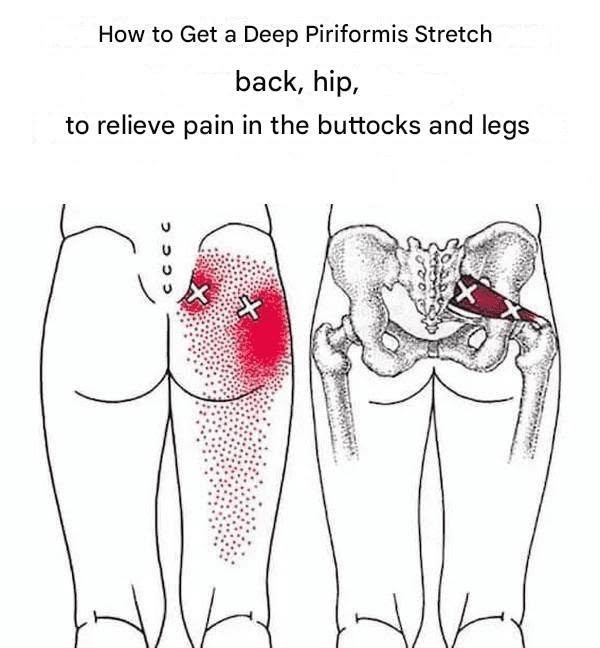
The piriformis muscle runs deep in the gluteal region, directly over the sciatic nerve. When tight, it compresses the nerve, causing sharp or dull radiating pain through the lower back, hip, buttock, and down the back of the leg (Piriformis Syndrome).
1. The Supine Figure-4 Stretch (Safest & Most Effective)
This variation protects the lower back while isolating the deep hip rotators.
2. Advanced: Pigeon Pose (For Greater Hip Mobility)
If the Figure-4 does not provide enough tension, transition to a kneeling position:
-
Begin on hands and knees (all-fours).
-
Bring your target knee forward behind your wrist, angling your shin inward toward the opposite hip.
-
Slide your back leg straight behind you, squaring your hips toward the floor.
-
Lower your upper body down toward forearms or a block. Hold for 45–60 seconds.
3. Targeted Myofascial Release (Lacrosse or Tennis Ball)
Stretching alone often relaxes the muscle temporarily. Using direct pressure breaks up deep tissue trigger points:
-
Sit on a solid floor and place a tennis or lacrosse ball directly under the fleshy part of your glute (the center of the buttock).
-
Cross the ankle of that same leg over the opposite knee.
-
Slowly roll over the ball until you find a tender spot.
-
Pause on that spot for 20–30 seconds, letting your body weight sink into the ball while taking deep, slow breaths.
Important Guidelines
| Do | Avoid |
| Flex your top foot to stabilize the knee | Forcing the stretch to the point of sharp pain |
| Keep the lower back flat against the floor in supine position | Arching or twisting the spine |
| Breathe slowly into the deep glute muscle | Bouncing dynamically during the stretch |
Note: If stretching triggers sharp, shooting numbness or electric shock sensations down your leg, stop immediately. This indicates nerve irritation rather than muscle tension—consult a physical therapist or medical professional for a lumbar disc evaluation.