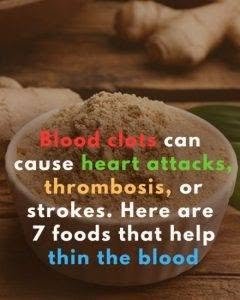
7 “blood-thinning” foods — what the evidence really says
The phrase “blood-thinning foods” is misleading. Foods don’t work like prescription anticoagulants, and eating a particular food should never be used to treat or prevent a blood clot without medical advice.
Some foods contain compounds that can modestly affect platelet activity or blood clotting, but the effects from ordinary portions are generally much weaker and less predictable than medication.
Seven foods commonly discussed in this context are:
Garlic 🧄 — Garlic compounds may have antiplatelet effects, particularly in concentrated preparations. Evidence that normal dietary amounts meaningfully “thin the blood” is limited.
Ginger — Laboratory and clinical research suggests possible effects on platelet aggregation, but it isn’t a substitute for an anticoagulant. A recent evidence review found that ginger may potentiate warfarin’s effects, highlighting the importance of medication interactions.
P
PubMed
Turmeric — Curcumin has been investigated for effects on platelet function, but evidence isn’t strong enough to recommend turmeric as a blood-thinning treatment.
Fatty fish 🐟 — Fish provides omega-3 fatty acids, which can have antiplatelet effects at sufficiently high intakes. Normal food portions are generally part of a healthy diet.
O
Office of Dietary Supplements
Berries 🫐 — They contain polyphenols that have been studied for effects on cardiovascular health, but calling them a “blood thinner” exaggerates the evidence.
Cocoa/dark chocolate — Cocoa flavanols may influence vascular and platelet function, but this doesn’t mean chocolate can prevent a dangerous clot.
Green tea 🍵 — Green tea contains compounds that may affect clotting, but it also contains vitamin K. For people taking warfarin, suddenly changing their intake can alter anticoagulation.
O
Office of Dietary Supplements
+1
⚠️ The important warning
If you take warfarin, don’t suddenly start eating large amounts of vitamin-K-rich foods such as spinach, kale, broccoli or other leafy greens. You don’t necessarily have to avoid them; the key is keeping your vitamin K intake reasonably consistent so your medication can be managed appropriately.
O
Office of Dietary Supplements
+1
Herbal supplements and concentrated extracts can be considerably more problematic than normal food portions because their doses are much higher and less predictable. Evidence on food/herb interactions with anticoagulants is still limited for many products.
P
PubMed
Bottom line: 🥗 These foods can be part of a heart-healthy diet, but calling them “powerful blood thinners” is an exaggeration. Don’t use garlic, ginger, turmeric, fish oil, or similar foods/supplements instead of prescribed anticoagulant medication. And don’t change your diet dramatically if you’re taking a blood thinner without discussing it with your doctor or pharmacist.
P
O
Sources