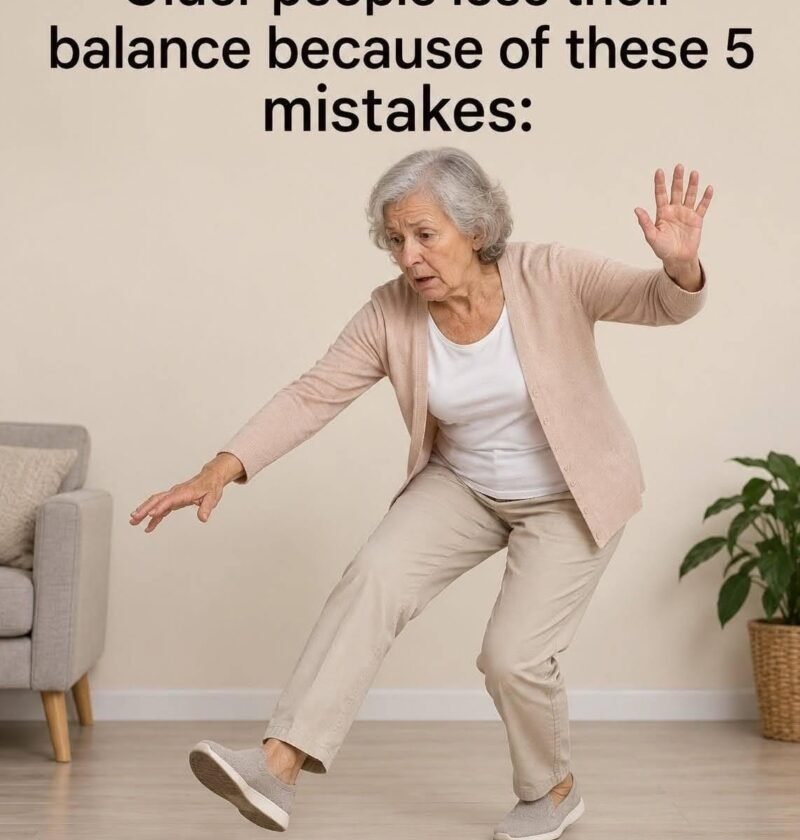
Maintaining good balance is essential for preserving independence and preventing dangerous falls as we age. However, everyday habits, environmental oversights, and common misconceptions about physical stability can quietly undermine coordination and stability.
Here are 5 common mistakes that can negatively affect balance in older adults, along with ways to correct them:
1. Locking the Knees During Standing or Exercise
When trying to stand tall or perform stability exercises, many people instinctively lock their knee joints backward.
-
The Problem: Hyperextending or locking your knees cuts off the subtle muscular micro-adjustments your lower legs and ankles need to make to keep you upright. It rigidifies your posture, making you more prone to toppling over if bumped or if your weight shifts.
-
The Fix: Keep a soft, natural bend in your knees (micro-bending them slightly). This keeps your leg muscles engaged and acts like shock absorbers, allowing you to react quickly to shifts in your center of gravity.
2. Looking Down at Your Feet While Walking
It feels counterintuitive, but staring straight down at your shoes to watch where you step actually shifts your center of gravity forward and throws off your alignment.
-
The Problem: When your head tilts downward, your body naturally follows, rounding your shoulders and compromising your core stability. Furthermore, it prevents you from seeing hazards further down your path (like a raised rug edge or uneven pavement).
-
The Fix: Practice keeping your chin level and your gaze focused forward (about 10 to 20 feet ahead). Trust your peripheral vision and your body’s spatial awareness to guide your feet.
3. Wearing Unsupportive or “Bad” Footwear Indoors
Many older adults spend a lot of time walking around the house in slippery socks, loose slippers, or completely barefoot.
-
The Problem: Smooth socks on hardwood or tile floors eliminate traction, while floppy slippers provide zero ankle support or feedback to the soles of your feet. Without sensory input from your feet, your brain struggles to calculate where your body is in space (proprioception).
-
The Fix: Wear supportive, closed-heel shoes or non-slip grip socks even when indoors. Look for footwear with firm, low-profile, non-skid rubber soles that allow you to feel the ground while maintaining secure traction.
4. Overlooking Home Environmental Hazards (Clutter and Dim Lighting)
Even someone with great core strength and balance can be tripped up by preventable obstacles in their living space.
-
The Problem: Relying solely on physical stability while ignoring environmental traps—such as loose throw rugs, electrical cords snaking across hallways, or poorly lit stairwells—drastically increases fall risk. Balance is a partnership between your body and your environment.
-
The Fix: Audit your home for safety. Secure or remove loose area rugs, clear floor clutter, install nightlights along pathways from the bedroom to the bathroom, and add grab bars near staircases and in the shower.
5. Neglecting Strength Training and Leg Power
A common mindset is that balance is purely a neurological trait or a matter of “inner ear health,” leading many to avoid leg-strengthening exercises.
-
The Problem: Balance requires physical power. If you stumble, your body relies on rapid, strong contractions in your ankles, calves, hips, and thighs to catch yourself. If those muscles are weak, a minor slip becomes an unavoidable fall.
-
The Fix: Incorporate gentle lower-body strengthening exercises into your routine—such as unweighted sit-to-stands from a sturdy chair, heel raises, and side leg lifts. Stronger leg muscles directly translate to better stability and quicker recovery reactions.
💡 Pro Tip: When practicing balance exercises at home (like standing on one foot), always position yourself next to a sturdy, unmoving kitchen counter or the back of a heavy chair so you can use just one fingertip for light, reassuring support.