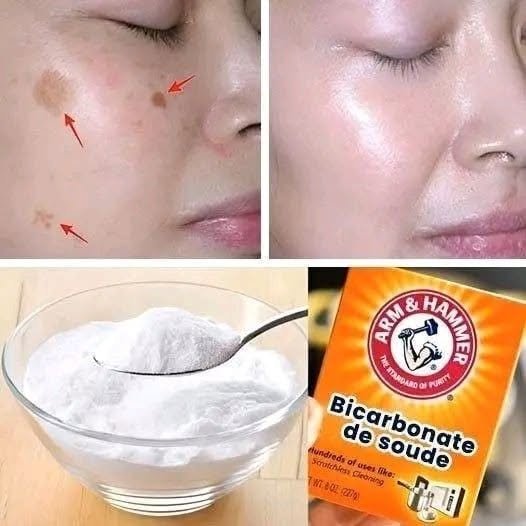
Baking soda is often promoted online as a natural way to erase these spots. However, there is no good clinical evidence that applying baking soda to the skin removes age spots. Because baking soda is alkaline and can disturb the skin barrier, using it frequently may cause dryness, redness, burning, or peeling.
If you’re interested in gentle home skincare, here are four approaches to consider.
1. Don’t use baking soda as a harsh facial scrub
A common DIY method is mixing baking soda with water and rubbing the paste onto dark spots. Although this can make the skin feel temporarily smoother, the effect comes from physical exfoliation rather than removal of the pigmentation.
Repeated scrubbing can irritate the skin and potentially make discoloration more noticeable, particularly in people prone to post-inflammatory hyperpigmentation.
If you nevertheless use baking soda on your skin, avoid vigorous rubbing, don’t apply it to broken or irritated skin, and discontinue it if you experience burning or persistent redness. For facial care, a properly formulated exfoliating product is generally a better choice.
2. Prioritize daily sunscreen
This is one of the most important steps for preventing age spots from becoming darker and helping prevent additional sun-induced pigmentation.
Use a broad-spectrum sunscreen with SPF 30 or higher on exposed skin and reapply when appropriate, especially during prolonged outdoor exposure. Hats, shade, and protective clothing can provide additional protection.
Without consistent UV protection, treatments aimed at fading pigmentation are less likely to produce lasting results.
3. Choose proven ingredients instead of DIY acids or scrubs
If your goal is gradually improving uneven pigmentation, look for skincare products containing ingredients with evidence for treating hyperpigmentation.
Depending on your skin and the cause of the discoloration, options can include:
-
Azelaic acid – commonly used for uneven pigmentation and acne-related discoloration.
-
Retinoids – can encourage skin-cell turnover and are used for several pigmentation concerns.
-
Vitamin C – topical formulations may help with uneven skin tone and provide antioxidant protection.
-
Hydroxy acids such as glycolic or lactic acid – can exfoliate the skin when appropriately formulated.
-
Niacinamide – may help improve the appearance of uneven pigmentation and is generally well tolerated.
Introduce one active product at a time and follow its directions. More products aren’t necessarily better; irritation can make pigmentation worse.
4. Have persistent or unusual spots checked
Not every brown spot is an ordinary age spot. Some skin cancers and precancerous lesions can resemble benign pigmentation.
A spot deserves medical evaluation if it is new, changing in size, shape, or color, has an irregular appearance, repeatedly bleeds or crusts, or otherwise looks different from your other spots.
A dermatologist can determine whether a lesion is actually a solar lentigo and discuss treatments such as prescription medicines, chemical peels, cryotherapy, or laser/light-based procedures when appropriate.
What about a baking-soda paste?
There’s a big difference between something being popular online and something being clinically established.
Baking soda can act as a mild abrasive, but that doesn’t mean it removes the excess pigment responsible for an age spot. Its relatively alkaline nature can also interfere with the skin’s normal environment and cause irritation.
For that reason, don’t rely on baking soda as an age-spot treatment, and particularly avoid leaving a concentrated paste on your face for prolonged periods.
A gentler routine for uneven skin tone
A simple routine can be more useful than a collection of DIY remedies:
Morning
-
Gentle cleanser.
-
Optional brightening product such as vitamin C or niacinamide.
-
Moisturizer if needed.
-
Broad-spectrum SPF 30+ sunscreen.
Evening
-
Gentle cleanser.
-
One appropriate pigmentation treatment, such as azelaic acid or a retinoid.
-
Moisturizer.
Start slowly, particularly if your skin is sensitive. Stop an active ingredient if it causes significant irritation.
The takeaway
Baking soda may be inexpensive and readily available, but there isn’t strong evidence that it can erase age spots. Aggressive DIY applications can actually irritate the skin and potentially worsen discoloration.
For more even-looking skin, focus on sun protection, gentle skincare, and ingredients with established evidence. And if a pigmented spot is changing or unusual, have it examined rather than trying to remove it at home.