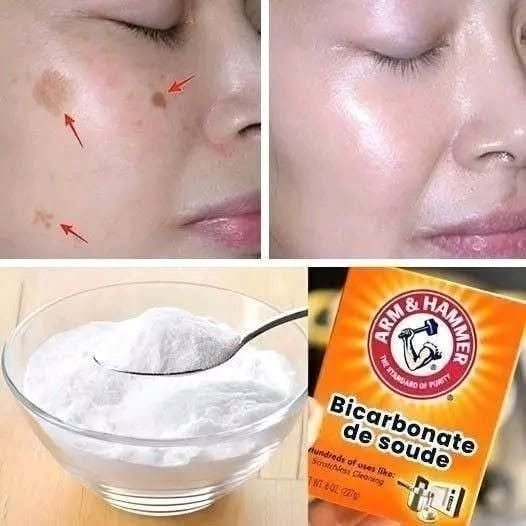
🧴 “4 Ways to Erase Age Spots With Baking Soda” — Fact-Checked
This is a popular DIY beauty claim, but baking soda is not a proven treatment for age spots. There is no good clinical evidence that rubbing or applying baking soda to pigmentation will safely erase it.
In fact, irritating the skin can make dark spots darker, particularly in people prone to hyperpigmentation. Dermatologists recommend gentle, non-irritating skincare instead. (American Academy of Dermatology)
❌ Be cautious with recipes such as:
- Baking soda + lemon juice
- Baking soda scrubs
- Baking soda mixed with toothpaste
- Baking soda paste left on overnight
These can irritate or dry the skin without reliably removing pigmentation.
✅ What has better evidence?
1. Sunscreen every day
Use broad-spectrum SPF 30 or higher. Sun protection helps prevent new spots and can help existing pigmentation fade. (American Academy of Dermatology)
2. Proven skin-care ingredients
Depending on the cause of the pigmentation, dermatologists may recommend ingredients such as retinoids, vitamin C, glycolic acid, azelaic acid, or kojic acid. (American Academy of Dermatology)
3. Professional treatments
For genuine sun-related age spots, dermatologists can use treatments such as laser therapy, cryotherapy, chemical peels, or microdermabrasion. (American Academy of Dermatology)
4. Get unexplained spots checked first
What looks like an ordinary age spot can sometimes be an actinic keratosis or skin cancer. The AAD recommends having suspicious spots evaluated before attempting cosmetic treatment. (American Academy of Dermatology)
Bottom line
Skip the baking soda. It isn’t a proven age-spot remover, and irritating your skin can make pigmentation worse. A gentle routine, daily sunscreen, and an evidence-based treatment are safer choices.