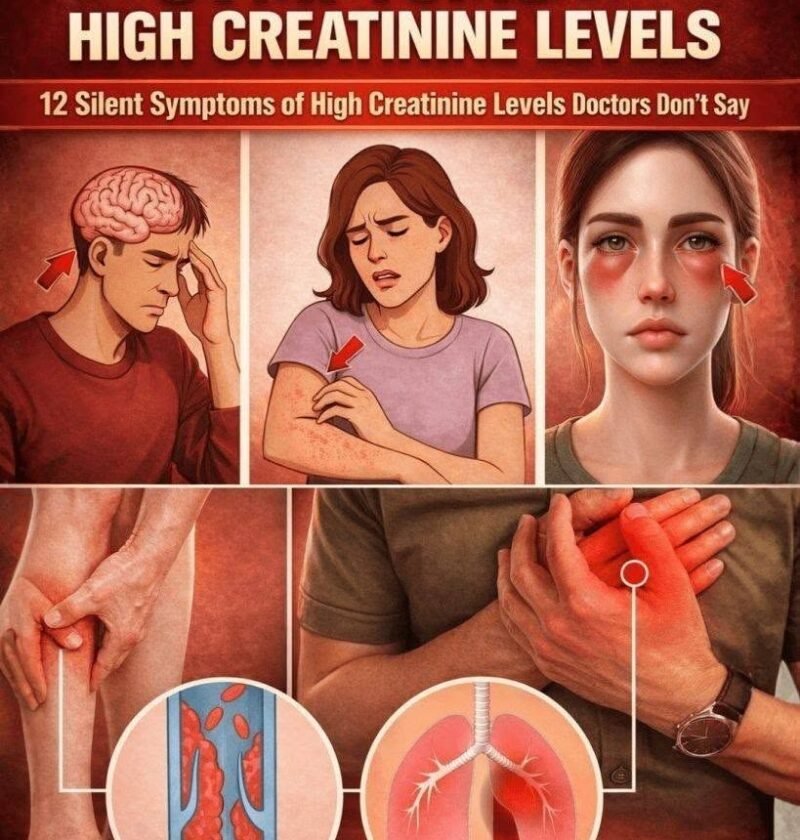
If you’re referring to “12 subtle signs of high creatinine that could point to early kidney disease,” there’s an important distinction: high creatinine itself usually does not cause symptoms. Early chronic kidney disease (CKD) often causes no noticeable symptoms, which is why blood and urine testing is more reliable than trying to identify symptoms. National Kidney Foundation+1
12 possible warning signs
These can occur with kidney disease, particularly as kidney function declines, but none by itself proves that creatinine is high:
-
Unusual tiredness or low energy
-
Puffiness around the eyes, especially in the morning
-
Swelling of the feet, ankles, or legs
-
Urinating more often, particularly at night
-
Urinating less than usual
-
Foamy or unusually bubbly urine, which can indicate protein in the urine
-
Blood in the urine
-
Dry or itchy skin
-
Muscle cramps, especially at night
-
Poor appetite
-
Nausea or vomiting
-
Difficulty concentrating or feeling mentally “foggy”
Several of these are more characteristic of later kidney disease, rather than early CKD. National Kidney Foundation+1
The important part: test rather than guess
A raised creatinine can happen for reasons other than kidney disease, including muscle mass, diet, dehydration, and certain medical conditions or medications. Therefore, a creatinine number should generally be interpreted alongside eGFR rather than by itself. National Kidney Foundation
For detecting kidney disease, two particularly useful tests are:
-
eGFR — estimates how well your kidneys filter blood.
-
uACR (urine albumin-to-creatinine ratio) — detects albumin/protein leaking into the urine, which can be an early sign of kidney damage. National Kidney Foundation
If you have a creatinine result, tell me the value and unit (for example, 1.4 mg/dL), your age, and sex, and I can explain what it generally means and how it relates to eGFR.