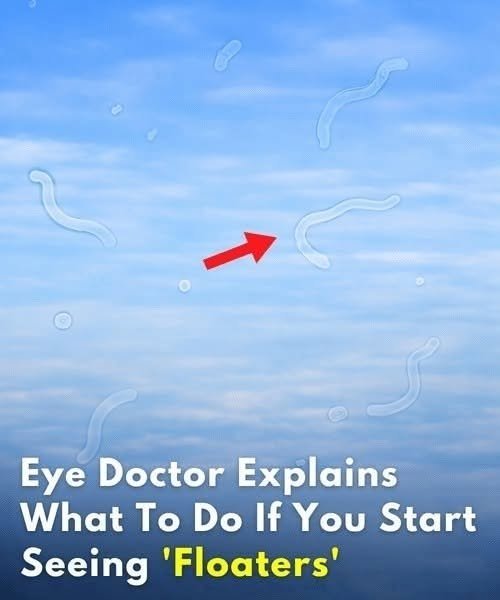
Viral health guides often frame eye floaters as either a harmless everyday quirk or a terrifying harbinger of sudden blindness, leaving readers unsure of how to react when they spot a stray cobweb or dot drifting across their vision.
While seeing floaters is exceptionally common—especially as we age—understanding what is actually happening inside your eye helps separate normal, age-related changes from true ophthalmologic emergencies.
What Are Eye Floaters, and Why Do They Happen?
Your eyeball is filled with a clear, gel-like substance called the vitreous humor, which helps the eye maintain its round shape.
-
The Normal Aging Process: As you age, the vitreous gel naturally liquefies and shrinks slightly, causing microscopic collagen fibers within the gel to clump together.
-
Casting Shadows: When light passes through your eye, these tiny clumps cast shadows onto your retina (the light-sensitive tissue at the back of your eye). What you actually “see” are the drifting shadows of those microscopic fibers appearing as dots, threads, rings, or spiderwebs floating across your field of vision.
The Reality: When Floaters Are Normal vs. When They Aren’t
For the vast majority of people, floaters are a benign, permanent part of visual aging. Once they appear, your brain often learns to ignore them, and they gradually settle out of your direct line of sight.
However, ophthalmologists and optometrists emphasize that a sudden change in floaters can signal a structural crisis inside the eye.
Red Flags: When Floaters Require Urgent Medical Evaluation
If you notice a sudden shift in your vision, you need to watch for specific warning signs that indicate a posterior vitreous detachment (PVD) or, more critically, a retinal tear or detachment:
-
A Sudden “Shower” of New Floaters:
-
What it means: Suddenly seeing dozens of new dots, spots, or a dark “cobweb” appear all at once is a major warning sign.
-
-
Flashing Lights (Photopsia):
-
What it means: Seeing brief, flickering streaks of light (like camera flashes or lightning) in your peripheral vision. This happens when the shrinking vitreous gel pulls physically on the retina.
-
-
A Dark “Curtain” or Shadow:
-
What it means: A gray curtain, shadow, or blurry wall moving across any part of your field of vision. This is a classic symptom of a retinal detachment, where the retina pulls away from the back wall of the eye.
-
-
Sudden Blurred Vision Accompanying Floaters:
-
What it means: A rapid drop in visual clarity alongside new floaters and flashes.
-
What to Do If You Notice New Floaters
-
Get a Dilated Eye Exam: If you experience a sudden onset of new floaters—especially if accompanied by flashing lights—do not wait. Schedule an urgent appointment with an optometrist or ophthalmologist for a dilated eye exam.
-
Why Dilated Exam Matters: Only an eye doctor looking through a dilated pupil can safely inspect the peripheral retina to verify whether it is intact or if a tear has occurred. Timely laser treatment or a simple procedure can easily repair a small retinal tear before it progresses to a full detachment.
If your floaters are old, stable, and something you’ve lived with for years without flashes or vision loss, they are usually just a normal part of life’s visual mileage!