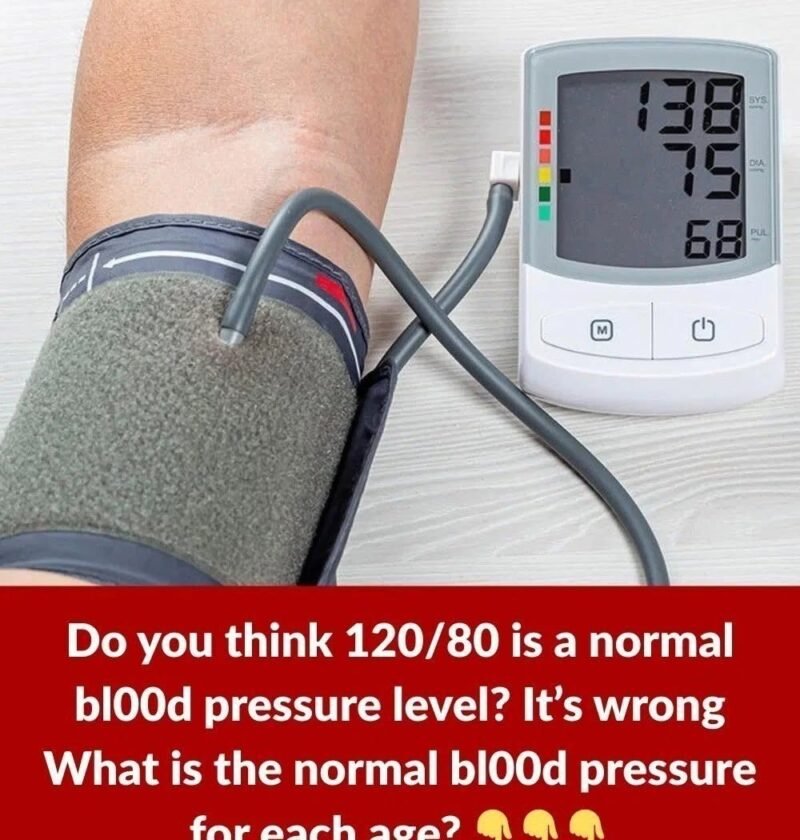
A common myth is that normal blood pressure increases as you get older (such as the old rule of “100 plus your age”). According to major medical guidelines—including those from the American Heart Association (AHA) and American College of Cardiology (ACC)—ideal, normal blood pressure for all adults is less than 120/80 mmHg, regardless of age.
While it is true that blood pressure naturally tends to drift upward as people age due to the gradual stiffening of arteries, “common” does not mean “healthy” or “normal.” Higher readings at any age still carry increased cardiovascular risks.
Adult Blood Pressure Categories (AHA/ACC Guidelines)
For any adult (age 18 and older), blood pressure readings are categorized as follows:
| Category | Systolic (Top Number) | Diastolic (Bottom Number) | |
| Normal | Less than 120 | and | Less than 80 |
| Elevated | 120 – 129 | and | Less than 80 |
| Stage 1 Hypertension | 130 – 139 | or | 80 – 89 |
| Stage 2 Hypertension | 140 or higher | or | 90 or higher |
| Hypertensive Crisis | Higher than 180 | and/or | Higher than 120 (Seek immediate care) |
(Note: If the top and bottom numbers fall into two different categories, the higher category is used. For example, a reading of 118/86 mmHg is classified as Stage 1 Hypertension because the bottom number falls into the 80–89 range.)
How Blood Pressure Varies Across Life Stages
While the medical definition of “normal” remains under 120/80 mmHg for all adults, how blood pressure looks across different phases of life involves a few distinct nuances:
1. Infants and Children
Blood pressure targets for children are entirely different from adults. They are not based on a flat number, but are instead calculated using a child’s age, height, and gender, plotted against pediatric percentiles by a pediatrician.
2. Young Adults (Ages 18–39)
-
What to expect: Readings typically hover on the lower side (often averaging around 110–120 / 70–80 mmHg).
-
Focus: Establishing a baseline. Catching and managing early upward trends (like “Elevated” blood pressure) in your 20s or 30s makes it much easier to prevent full hypertension later in life.
3. Middle-Aged Adults (Ages 40–59)
-
What to expect: Systolic pressure (the top number) begins a steady climb as blood vessels naturally lose some of their elasticity.
-
Focus: Keeping a close eye on the top number. Lifestyle adjustments—such as regular exercise, reducing sodium intake, and managing stress—are vital in this window.
4. Older Adults (Ages 60 and Beyond)
-
What to expect: It is very common for the top number to continue rising while the bottom number levels off or even drops (known as isolated systolic hypertension).
-
Focus: While the optimal target remains below 120/80 mmHg, doctors often individualize treatment goals for older adults. For instance, for individuals over 65 or those managing frailty or fall risks, a clinician may set a practical target of below 130/80 mmHg or slightly higher to balance cardiovascular protection with safety from dizziness or fainting.
A Quick Note on Readings
A single high reading does not automatically mean you have hypertension; blood pressure fluctuates constantly throughout the day based on stress, caffeine, physical activity, and even how the cuff is positioned. If you are tracking your numbers, it is best to take them when you are calm and seated quietly for five minutes.
Are you looking at a specific blood pressure reading for yourself or a family member that you’d like to discuss?