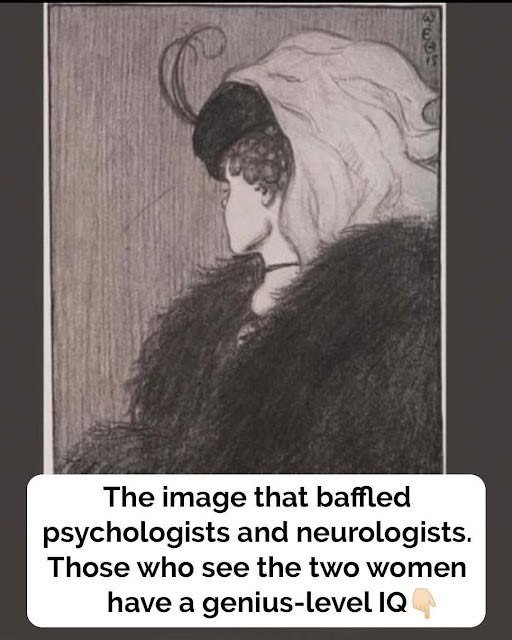
The headline “The image that baffled psychologists and neurologists. Those who see the two women have a genius-level IQ. See the first comment for what you need to do…” is a classic piece of social media engagement bait. It combines an impossible scientific authority (“baffled psychologists”), an appeal to ego (“genius-level IQ”), and a classic clickbait cliffhanger (“see the first comment”) designed to drive comments, shares, and algorithmic reach.
In psychological and neurological reality, no standard visual puzzle or optical illusion can measure your IQ, nor do these images “baffle” trained researchers.
Let’s look at why these illusions go viral and how the human brain actually processes complex visual scenes.
The Reality Behind “Genius” Optical Illusions
When you stumble across an image that contains a hidden second picture—such as a classic face-vase illusion, a sketch that can be interpreted as a young woman or an old woman, or overlapping silhouettes—your brain is simply performing normal pattern recognition.
Here is what is actually happening in your visual cortex:
-
Gestalt Switching (Multistable Perception): The human brain loves to make sense of ambiguous lines. When an artist designs an optical illusion, they intentionally use contour lines that can serve a dual purpose (for example, the chin of an old woman forming the nose or jawline of a young woman). Your brain can usually only focus on one interpretation at a time, so it rapidly “switches” back and forth between the two configurations.
-
Visual Processing Speed vs. Intelligence: Noticing both figures quickly has nothing to do with having a “genius-level IQ.” It depends entirely on visual scanning habits, your familiarity with specific types of abstract art, and where your eyes happen to land first.
-
The Psychology of Engagement Bait: Phrases like “only 1% of people can see this” or “implies a high IQ” exploit a psychological phenomenon called the superiority illusion. People love to believe they possess a hidden, superior trait, making them far more likely to comment “I saw both instantly!” or share the post, which feeds the algorithm.
The Takeaway
Enjoying an optical illusion is a fun way to appreciate how the cerebral cortex processes visual data, but it won’t tell you anything about your IQ. True intelligence is measured through comprehensive cognitive, verbal, and problem-solving evaluations—not by whether you spot a hidden face in a sketch on your social media feed.