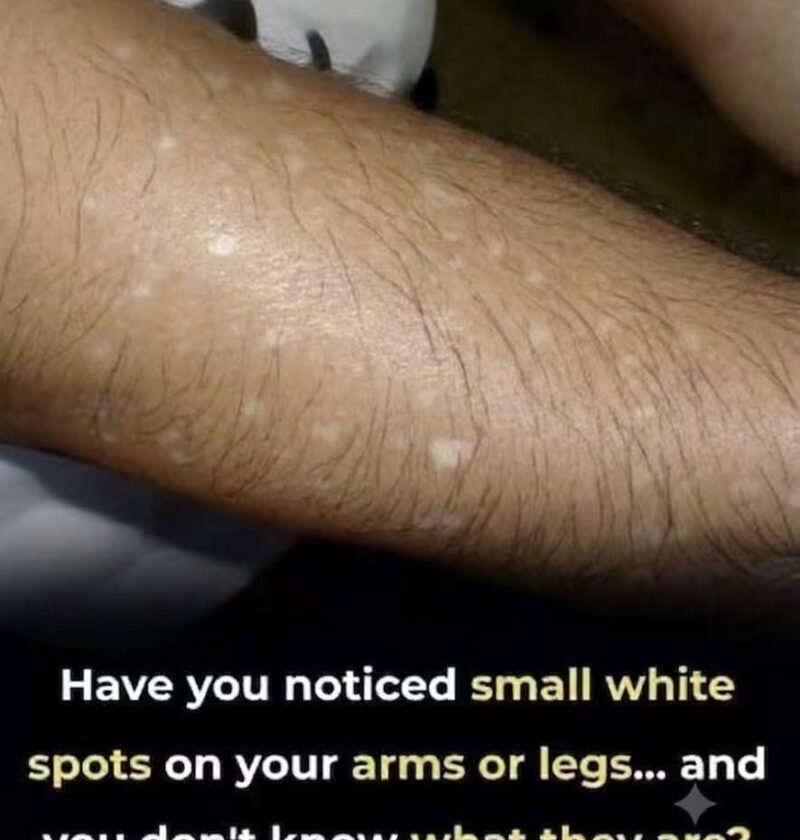
Most small white spots on the arms and legs are harmless, everyday skin changes—most commonly sun-related pigment drop-out (idiopathic guttate hypomelanosis) or a mild surface yeast overgrowth (tinea versicolor)—rather than a sign of internal organ disease, serious vitamin deficiency, or contagious infection.
Articles titled “Small White Spots on Arms and Legs You Need To Know” often spark unnecessary alarm by jumping straight to rare conditions or blaming “toxins” and “liver trouble.” In dermatology, the size, texture, scale, and location of the spots quickly narrow down what is actually happening.
The Most Common Causes of Small White Spots on Arms & Legs
| Condition | What It Looks & Feels Like | Why It Happens & Typical Care |
| Idiopathic Guttate Hypomelanosis (IGH) | Tiny (2–5 mm), flat, smooth, porcelain-white “confetti” dots on sun-exposed shins and forearms; no itching or scaling. | Cumulative UV sun exposure + normal skin aging (very common after age 40). Harmless—sunscreen prevents new spots, though existing dots usually stay permanent. |
| Tinea Versicolor (Pityriasis Versicolor) | Light, pale, or slightly pink/tan patches that can merge together; often has a very fine, powdery scale when gently scratched and may itch mildly. | Overgrowth of normal skin yeast (Malassezia) in warm, humid weather or oily skin. Treated easily with over-the-counter or prescription antifungal washes/creams (selenium sulfide, ketoconazole). |
| Post-Inflammatory Hypopigmentation | Flat light spots left behind after a bug bite, scrape, burn, eczema flare, or rash heals. | Temporary slowdown in pigment (melanin) production while skin recovers; usually fades back to normal skin tone over weeks to months. |
| Pityriasis Alba | Faint, dry, slightly scaly pale patches with soft, blurry borders—most common in children/young adults or people with dry/eczema-prone skin. | Mild, low-grade eczema inflammation made more visible when surrounding skin tans; improves with gentle fragrance-free moisturizers and daily sunscreen. |
| Vitiligo | Smooth, completely chalk-white patches with sharp borders that tend to slowly expand over time (often symmetric around hands, wrists, elbows, knees, or face). | Autoimmune loss of pigment-producing cells (melanocytes). Not contagious or dangerous physically, and treatable with targeted prescription creams or light therapy if desired. |
Helpful Clues to Tell Them Apart (and What Not to Do)
-
Check texture and borders:
-
Tiny (2–5 mm), smooth, flat dots scattered on shins/forearms that never merge → strongly points toward sun spots (IGH).
-
Fine surface flaking or spots that merge in warm weather → points toward tinea versicolor.
-
Chalk-white patches with crisp borders that slowly grow → warrants a dermatologist check for vitiligo.
-
-
Skip harsh DIY “cures”: Rubbing lemon juice, garlic, vinegar, or undiluted essential oils onto light spots irritates the skin and can worsen uneven pigmentation.
-
Use daily broad-spectrum sunscreen (SPF 30+): Even when spots are harmless, tanning the surrounding skin increases contrast and makes white spots look much more prominent.
When to see a dermatologist: Have white spots evaluated if they are spreading or enlarging rapidly, have sharp chalk-white borders, itch, crust, bleed, or feel thickened/raised, or fail to improve after trying a gentle moisturizer or basic over-the-counter antifungal wash.