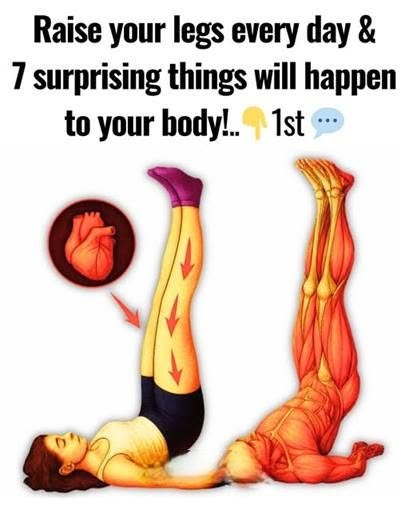
🦵 Raise Your Legs Every Day: What Can It Actually Do?
Elevating your legs for a while can be useful, especially after prolonged standing or sitting. But viral claims that it causes seven dramatic changes throughout the body are exaggerated.
Here are some realistic effects:
- May temporarily reduce leg swelling
Elevating the legs above heart level can help fluid move back toward the circulation. - Can relieve feelings of heaviness
People who spend much of the day standing may find their legs feel less tired afterward. - May improve comfort from venous pooling
Gravity can cause blood and fluid to accumulate in the lower legs; elevation temporarily counteracts this. - Can be relaxing
A few minutes of comfortable elevation can provide a simple rest period. - May help after prolonged sitting or travel
Moving your legs regularly and changing position are more important overall, but elevation can be a useful addition. - Can complement treatment for some causes of swelling
For example, clinicians may recommend leg elevation alongside compression and movement for certain venous conditions. - It isn’t a “detox” or cure-all
Leg elevation doesn’t cleanse the blood, burn belly fat, cure arthritis, or permanently improve circulation by itself.
How to do it
Lie down and support your legs with pillows so that your feet are comfortably elevated above your heart. Try about 15–30 minutes, provided the position is comfortable. Don’t remain completely still for long periods—regular walking and ankle movement are important too.
🚨 When swelling needs medical attention
Sudden swelling in one leg, particularly with pain, warmth, or redness, can indicate a blood clot and requires prompt medical assessment. If leg swelling occurs with chest pain or shortness of breath, seek emergency care.
Persistent swelling in both legs can also be caused by heart, kidney, liver, medication, or venous problems and should be evaluated rather than simply treated with elevation.
Bottom line: Raising your legs can be a simple way to temporarily reduce swelling and heaviness, but it isn’t a miracle therapy. The benefit depends on why your legs are swollen in the first place.