Over 200 People Are Killed by the “World’s Deadliest Food” Every Year — Yet Nearly 500 Million Still Eat It
It sounds almost impossible: a food eaten by hundreds of millions of people can also contain a naturally occurring poison. Yet that is the unusual story of cassava, a major staple across tropical regions.
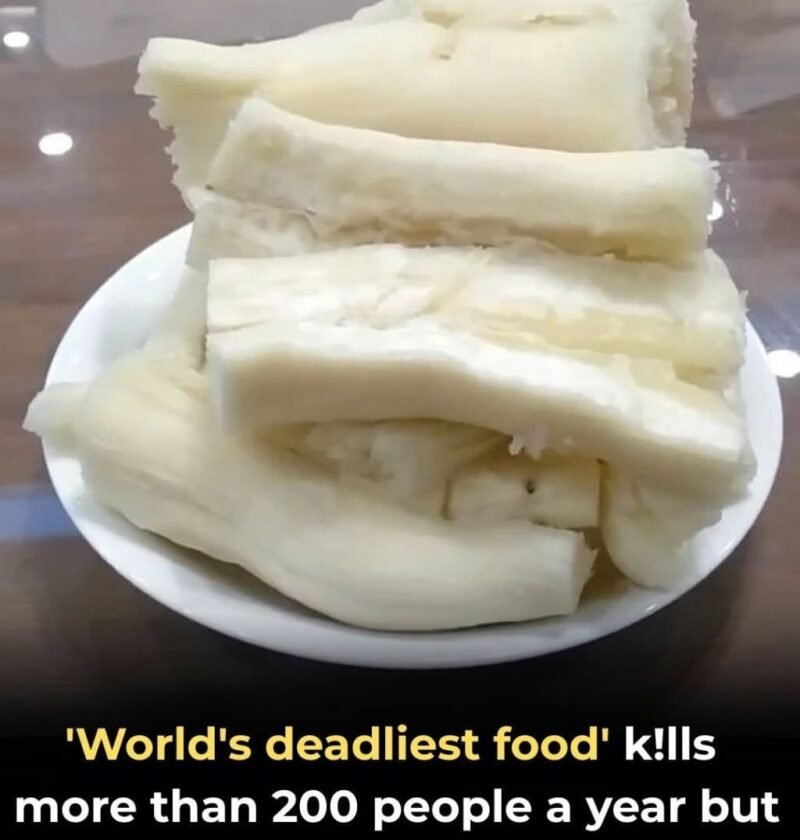
Cassava is sometimes sensationally called the “world’s deadliest food.” The nickname comes from its potential to cause cyanide poisoning when it is improperly processed—not because cassava is inherently unsafe. Historical and scientific sources estimate that cassava is a staple for roughly 500 million people, while WHO-linked estimates have put deaths from cassava poisoning at more than 200 per year.
🌱 What is cassava?
Cassava, also known as manioc or yuca, is a starchy root crop originally from South America. It is particularly valuable in tropical regions because the plant tolerates difficult growing conditions and can provide substantial calories.
It is used to make foods including cassava flour, tapioca, gari and fufu. For millions of households, it isn’t an exotic or unusual food—it’s an important source of everyday energy.
☠️ So what makes it dangerous?
The concern is cyanogenic glycosides, naturally occurring compounds found in cassava. When plant tissue is damaged, these compounds can break down and release hydrogen cyanide, a powerful toxin.
The amount varies considerably between varieties and growing conditions. Bitter varieties generally contain substantially more cyanogenic compounds than sweeter varieties.
That’s why eating raw or inadequately processed cassava can be dangerous.
⚠️ What can cyanide exposure do?
A sufficiently high exposure can cause acute cyanide poisoning. Symptoms can include:
- Headache and dizziness
- Nausea and vomiting
- Stomach pain
- Rapid breathing
- Confusion
- Seizures
- Loss of consciousness
- In severe cases, death
Lower-level or repeated exposure is also associated with serious neurological problems. One condition linked to high cyanide exposure from inadequately processed cassava is konzo, a neurological disorder that can cause permanent difficulty walking and paralysis.
🍽️ Why do so many people continue eating it?
Because properly processed cassava can be a safe and valuable food.
Communities that traditionally consume cassava have developed processing methods designed to reduce its cyanogenic compounds. Depending on the variety and food product, processing can involve peeling, grating, soaking or fermentation, drying and thorough cooking. Research shows that appropriate processing can substantially reduce cyanide levels.
The important distinction is therefore:
Cassava isn’t “poisonous food” that people somehow tolerate. It is a food containing naturally occurring toxins that must be properly processed.
🌍 When does the risk become greater?
Cassava poisoning can become a particular concern during drought, famine, food shortages and other situations where normal processing practices are disrupted. People may depend more heavily on cassava, use higher-toxin varieties, or shorten processing because they urgently need food.