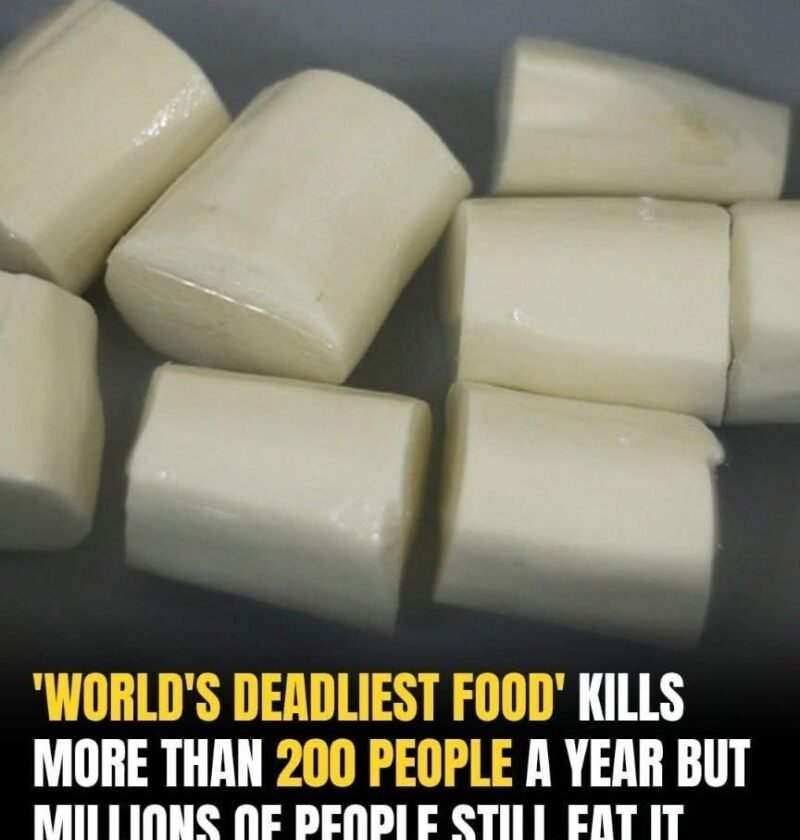
Over 200 People Are Killed by the “World’s Deadliest Food” Every Year — But Almost 500 Million Still Eat It
The food behind this alarming headline is cassava, also known as manioc or yuca. But the phrase “world’s deadliest food” is sensationalized: cassava is an important staple food, and it becomes dangerous primarily when varieties containing high levels of natural toxins are eaten raw or inadequately processed.
L
Live Science
+1
🌱 Why can cassava be poisonous?
Cassava naturally contains cyanogenic glycosides. When the plant is damaged, chewed, or inadequately processed, these compounds can release hydrogen cyanide, a potent toxin. The amount varies substantially between varieties, with bitter cassava generally presenting a greater risk than sweet varieties.
L
Live Science
+1
☠️ What can happen if it’s improperly prepared?
Significant cyanide exposure can cause symptoms such as:
Headache and dizziness
Nausea and vomiting
Weakness
Rapid breathing
Confusion
Seizures
Loss of consciousness
In severe cases, death
Long-term exposure to insufficiently processed, high-cyanide cassava has also been associated with serious neurological disorders, including konzo, a condition characterized by irreversible spastic weakness or paralysis of the legs.
L
Live Science
+1
A real-world example occurred in Uganda in 2017, when an outbreak linked to contaminated cassava flour resulted in 98 suspected poisoning cases and two deaths.
C
CDC
🍽️ So why do hundreds of millions eat it?
Because properly processed cassava can be an important and nutritious source of calories. Cassava is widely consumed across tropical regions, particularly in Africa, Asia and Latin America. WHO materials note that roughly 200 million people derive a substantial proportion of their daily calories from cassava, while older estimates commonly put the number of regular consumers at around 500 million.
I
Iris
+1
The apparent contradiction is therefore simple:
Cassava isn’t inherently a deadly food. Improperly processed cassava can be deadly.
⚠️ Preparation is critical
Traditional processing methods can include peeling, grating, soaking or fermenting, drying and thorough cooking, depending on the variety and the food being prepared. These processes are intended to reduce cyanogenic compounds to safe levels.
S
ScienceDirect
+1
Do not experiment with eating raw or inadequately processed cassava, particularly bitter cassava or unfamiliar wild varieties. Follow established local preparation practices and food-safety guidance.
The fascinating lesson