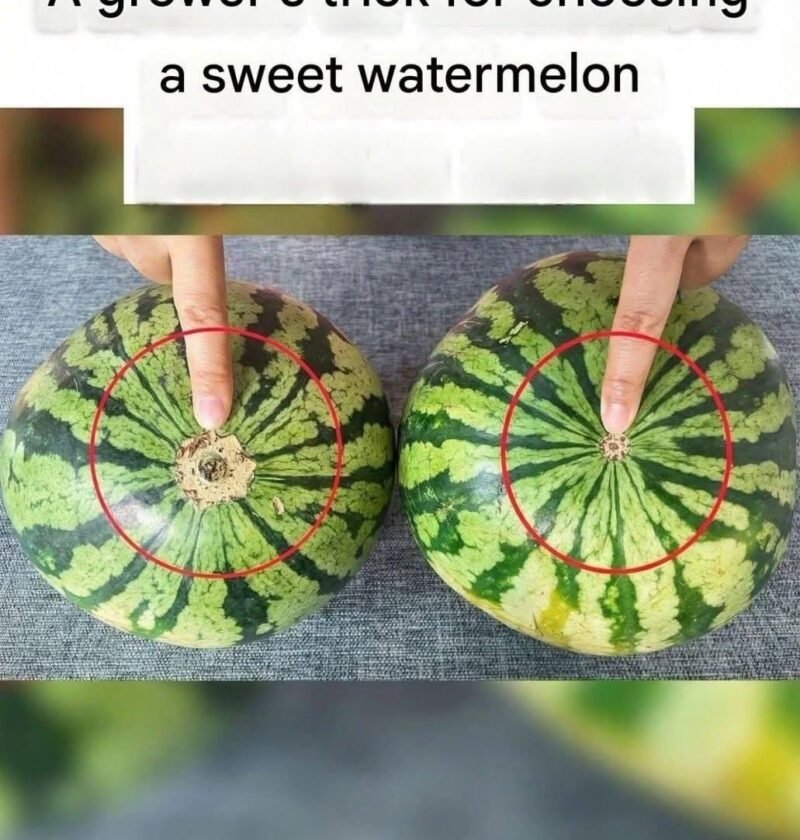
Say goodbye to chalky, pale, and flavorless watermelons. Picking a perfectly sweet, ripe melon at the grocery store or farmer’s market isn’t a guessing game—it is a science based on visual and physical cues left behind by the plant.
Here is the ultimate guide to choosing a winner every single time:
1. Look for the “Field Spot” (Creamy Yellow is Best)
The field spot is the patch where the watermelon rested on the ground while growing.
-
What to avoid: A white or pale green spot means the melon was picked too early and didn’t get enough time to ripen on the vine.
-
What to look for: A deep, creamy yellow, orange, or even buttery gold spot. The darker the yellow, the longer it sat soaking up sun and sugar.
2. Check for Sugar Webbing (The Brown Scars)
Those rough, brown, web-like scars or dark scratch marks on the rind (often called “sugar spots” or “bee stings”) are actually a great sign.
-
What it means: It indicates that bees repeatedly pollinated the flower’s sugar scars. The more webbing you see, the sweeter the melon inside tends to be.
3. Tap and Listen (The “Thump” Test)
Give the watermelon a firm pat or thump with your knuckles or fingertips.
-
Underripe/Unripe: Produces a sharp, high-pitched, ringing sound (like tapping a hollow drum). It usually means the flesh is dense and hasn’t developed its juice yet.
-
Overripe: Produces a dull, deep thud. The interior may have started turning mealy or hollow.
-
Just Right: Produces a deep, resonant, hollow tenor sound—almost like a muted heartbeat or a muffled drum. It signals a crisp, juicy interior.
4. Inspect the Tail (Stem)
Take a look at the stem end of the melon where it was cut from the vine.
-
Green stem: Means it was picked too soon and might lack flavor.
-
Dry, brown, yellowish-brown stem: Means the watermelon matured fully on the vine and stopped growing naturally before harvest.
5. Heavy for Its Size
Lift two watermelons that look roughly the same size.
-
The rule: Pick the heavier one. Watermelon is about 92% water; a heavier melon means it is packed with juicy hydration, whereas a light one has likely started to dry out from the inside.