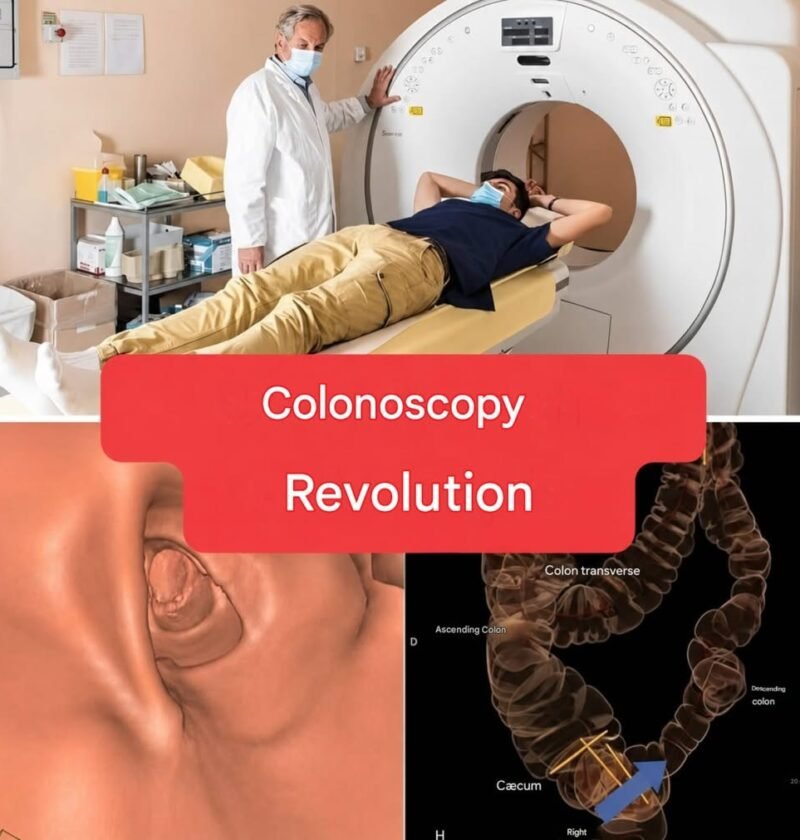
1. Virtual colonoscopy (CT colonography)
This is probably what the headline is referring to.
Instead of inserting a long flexible camera through the rectum, CT scans are used to create detailed 2D and 3D images of the colon. Computer processing produces a “virtual” view of the inside of the bowel. It is considered a non-invasive examination and generally does not require sedation.
How it works:
- The bowel still needs to be emptied/prepared.
- A small amount of air or CO₂ is introduced to expand the colon.
- A CT scanner takes images.
- Software reconstructs the colon digitally.
- The radiologist looks for polyps, tumors and other abnormalities.
2. The important limitation
A CT/virtual colonoscopy cannot remove a polyp or take a biopsy. If it discovers a suspicious polyp, the patient generally still needs a conventional colonoscopy so that doctors can remove it or obtain tissue for testing.
So it would be more accurate to say:
“A non-invasive alternative can detect many abnormalities without conventional colonoscopy, but conventional colonoscopy is still needed when tissue sampling or polyp removal is required.”
3. Another option: capsule colonoscopy
There is also colon capsule endoscopy. The patient swallows a capsule containing tiny cameras. As it travels through the digestive tract, it takes pictures of the colon. Research has shown that it can detect polyps and other lesions and can be useful when conventional colonoscopy cannot be completed.
However, like CT colonography, the capsule cannot remove a polyp or perform a biopsy.
4. There are also improvements to conventional colonoscopy
Some newer techniques don’t eliminate the colonoscope but make the procedure potentially more comfortable and more effective. For example, water-exchange colonoscopy uses water rather than large amounts of air during insertion, and a transparent cap can improve the view around folds of the colon. A pilot study found more adenomas detected per colonoscopy with this combined technique, although larger studies were needed to establish its benefit.
Bottom line
No, conventional colonoscopy has not become obsolete. The newer approaches can make colon examination less invasive, but they have important limitations:
| Method | Camera enters colon? | Can detect polyps? | Can remove/biopsy? |
|---|---|---|---|
| Conventional colonoscopy | Yes | ✅ | ✅ |
| CT/virtual colonoscopy | No | ✅ | ❌ |
| Capsule colonoscopy | Swallowed capsule | ✅ | ❌ |
If you send me part 2 of the article, I can identify exactly which “new method” the headline is talking about, explain how it works, and tell you whether it is actually available now or is still experimental.