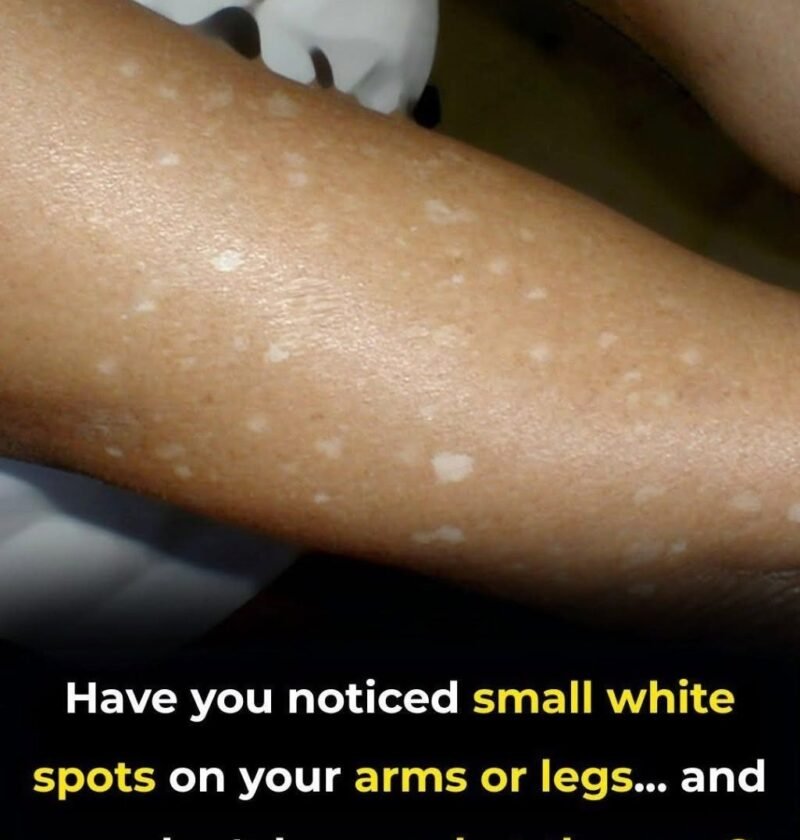
Small white spots on the arms or legs can have several causes, and most are not dangerous. The appearance, size, texture, and whether they are spreading make a big difference.
Common possibilities include:
-
Idiopathic guttate hypomelanosis (IGH): tiny, flat, smooth white spots, often on sun-exposed arms and legs. They become more common with age and are harmless.
-
Tinea versicolor: a superficial fungal infection that can produce lighter patches, sometimes with fine scaling. It more commonly affects the chest, back, neck, or upper arms.
-
Vitiligo: areas where pigment-producing cells are lost, producing more clearly defined white patches. They may gradually enlarge or appear in additional areas.
-
Post-inflammatory hypopigmentation: lighter marks left behind after eczema, irritation, an injury, or another skin inflammation.
-
Sun-related pigmentation changes: repeated sun exposure can make existing differences in pigmentation more noticeable.
When to get them checked
See a dermatologist if the spots are rapidly increasing, becoming completely white, developing around the mouth/eyes, associated with itching or scaling, or accompanied by hair turning white in the affected area. A clinician can usually narrow down the cause by examining the skin, sometimes using a Wood’s lamp or a simple skin scraping.
If you upload a clear photo of the spots (ideally one close-up and one showing the surrounding skin), I can help you identify which possibilities they most resemble.