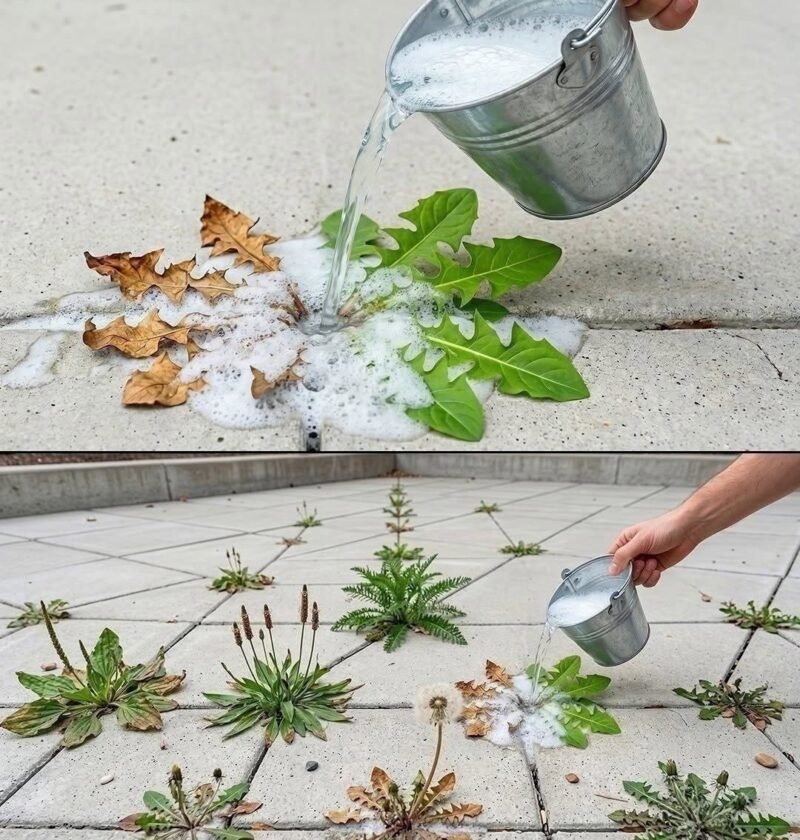
If you want a detailed educational post, here’s a practical version that focuses on safer homemade weed-control methods:
🌿 Natural and Powerful Homemade Weed Control
Tired of weeds taking over your garden, driveway, or paths? You don’t always need a strong commercial herbicide. Several simple, low-cost methods can help control unwanted weeds.
1. Boiling Water ♨️
One of the simplest options is boiling water.
Carefully pour freshly boiled water directly over the leaves and base of weeds. The heat damages the plant tissues and can kill small weeds.
Best for: Weeds growing through cracks in driveways, sidewalks, and patios.
⚠️ Be careful—boiling water can also damage desirable plants, grass, and soil organisms if applied where you don’t want it.
2. Hand Weeding + Mulch 🌱
For garden beds, physically removing weeds and then covering the soil is one of the safest approaches.
Pull or dig out weeds, including as much of the root as practical, then apply a layer of organic mulch such as:
- Straw
- Shredded leaves
- Wood chips
- Compost
Mulch blocks light and makes it harder for new weeds to emerge.
3. Vinegar — Use With Caution
Household vinegar can damage the leaves of many small weeds because its acidity dries out plant tissue.
However, vinegar is not a selective weed killer. It can injure desirable plants just as easily as weeds, and repeated use can affect soil conditions.
For that reason, avoid spraying it broadly over lawns or garden beds. Target individual weeds carefully and avoid windy conditions.
4. Smother Weeds With Cardboard 📦
For larger areas, cardboard can be useful.
Place plain cardboard over the unwanted vegetation, overlap the edges, wet it thoroughly, and cover it with mulch.
This blocks sunlight and gradually suppresses weeds underneath.
5. Don’t Let Weeds Go to Seed 🌾
Prevention is one of the most powerful forms of weed control.
Remove weeds before they produce flowers and seeds. Allowing mature weeds to spread seeds can create a much bigger problem the following season.
6. Keep Soil Covered
Bare soil provides an excellent opportunity for weeds to germinate.
Use mulch or appropriate ground-cover plants to reduce exposed soil. A covered garden bed generally requires less frequent weeding.
🚫 What About Salt?
Salt is sometimes promoted as a homemade weed killer, but it can damage soil and nearby plants and may make the area unsuitable for future growth.
It’s generally a poor choice for garden beds and anywhere you want healthy soil.
🌿 The Best Natural Strategy
For long-term control, don’t rely on one homemade spray. Combine:
Remove existing weeds → cover bare soil → mulch → maintain regularly → remove new weeds before they seed.
This approach is usually safer for gardens and more sustainable than repeatedly applying harsh homemade mixtures.
Important Safety Tip
Never mix household cleaning products, bleach, ammonia, or other chemicals together to make a weed killer. Dangerous gases or chemical reactions can result.
And always protect your eyes and skin when handling hot water or any concentrated substance.