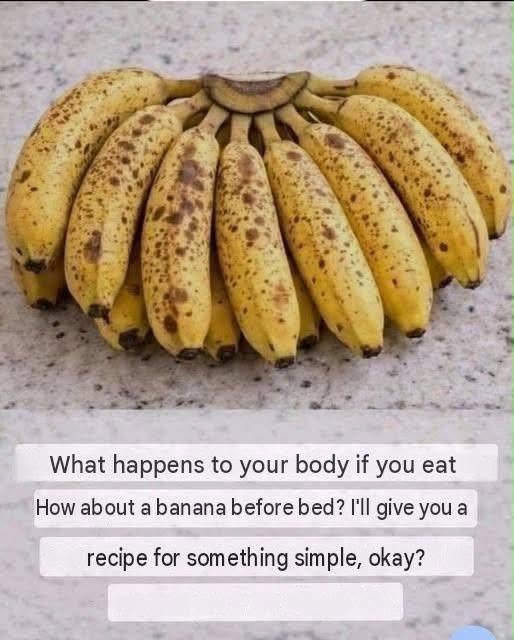
When you see that exact headline on social media—“If you eat bananas at night, you will increase your… See more”—clicking through reveals a specific breakdown of how a banana’s nutrients interact with your body right before sleep.
Depending on whether the post is promoting bananas as a natural sleep aid or warning against eating them late, here is the detailed physiological breakdown of every claim that usually follows that ellipsis:
1. The Sleep & Relaxation Claim: “…Melatonin, Serotonin, and Muscle Relaxation”
This is the most common positive angle behind the hook. A medium banana (about 118g) contains several compounds linked to sleep regulation:
-
Tryptophan (~11 mg): An essential amino acid your brain converts into serotonin (which regulates mood and relaxation) and then into melatonin (the hormone that signals your body it is time to sleep).
-
Magnesium (~32 mg, ~8% DV) & Potassium (~422 mg, ~9% DV): Both act as natural muscle relaxants. Magnesium helps quiet nervous system activity and regulates GABA receptors in the brain, while potassium helps prevent nighttime leg cramps and restless legs.
-
Vitamin B6 (~0.4 mg, ~25% DV): Acts as a necessary cofactor that helps your body actually convert tryptophan into serotonin and melatonin.
-
The Scientific Reality: While those nutrients genuinely support sleep architecture, the actual amounts in a single banana are too modest to act like a sedative. You won’t get knocked out by eating one, though pairing a banana with a small source of protein or healthy fat (like a spoonful of peanut butter or a handful of almonds) makes a genuinely good, steady-energy bedtime snack.
2. The Warning Claim: “…Blood Sugar, Insulin, and Late-Night Energy”
Health and weight-loss pages often flip the hook into a warning about nighttime carbs:
-
Carbohydrate & Sugar Load: One medium banana contains about 27 grams of carbohydrates, including roughly 14 grams of natural sugars (glucose, fructose, and sucrose) and 3 grams of fiber.
-
Ripeness Matters: A slightly green banana is rich in resistant starch, which digests slowly and barely spikes blood sugar. A heavily spotted, overripe banana has converted most of that starch into simple sugars, causing a faster rise in blood glucose and insulin.
-
The Scientific Reality: For a healthy person, eating a banana at night will not cause weight gain or disrupt sleep—total daily calories matter far more than meal timing. However, if you have diabetes, insulin resistance, or reactive hypoglycemia, eating a ripe banana alone late at night can cause a noticeable blood sugar spike followed by a dip that might wake you up around 2:00 or 3:00 AM.
3. The Traditional/Folk Medicine Claim: “…Mucus Production and Sluggish Digestion”
If the post comes from an Ayurvedic or traditional wellness page, it almost always warns that bananas at night increase Kapha (heaviness and mucus):
-
The Claim: Eating “cooling,” dense foods like bananas after sunset slows down digestive fire, leading to nasal congestion, phlegm, or waking up with a heavy, groggy feeling.
-
The Scientific Reality: Clinical studies have repeatedly shown that bananas (like dairy) do not cause your body to produce more mucus. However, because bananas are fairly dense and rich in fiber and sorbitol, eating one right before lying flat on your back can slow stomach emptying slightly—which may trigger acid reflux, bloating, or mild indigestion if you are already prone to heartburn.