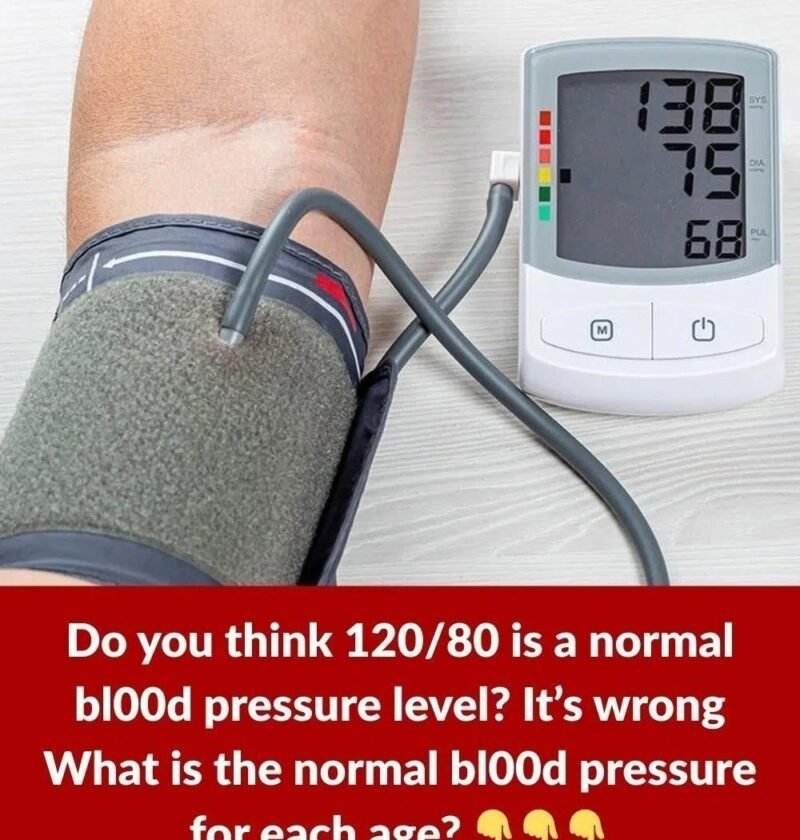
When looking at blood pressure, medical guidelines make a clear distinction between what is clinically normal and what is statistically average as people age.
According to major health organizations like the American Heart Association (AHA), the ideal target for all adults (ages 18 and older) is less than 120/80 mmHg. While blood pressure naturally tends to drift upward as people age due to normal arterial stiffening, a reading that is “common for an older age group” is not necessarily considered ideal or risk-free.
📊 Adult Blood Pressure Categories (Ages 18+)
For adults, readings are classified into the following categories based on whichever number is higher:
| Category | Systolic (Top Number) | Diastolic (Bottom Number) | |
| Normal | Less than 120 | and | Less than 80 |
| Elevated | 120–129 | and | Less than 80 |
| Hypertension Stage 1 | 130–139 | or | 80–89 |
| Hypertension Stage 2 | 140 or higher | or | 90 or higher |
| Hypertensive Crisis (Seek immediate care) | Higher than 180 | and/or | Higher than 120 |
📈 Typical Averages Across Life Stages
While the official healthy target remains below 120/80 mmHg across adulthood, population averages change across different decades of life:
-
Ages 18–39: Averages typically range from 110/68 to 120/78 mmHg. Younger adults generally maintain lower averages, making this an ideal window to establish healthy cardiovascular habits.
-
Ages 40–59: Averages typically range from 120/74 to 132/82 mmHg. This is frequently the decade where systolic pressure (the top number) begins a steady climb due to gradual changes in blood vessel elasticity.
-
Ages 60 and older: Averages typically range from 130/70 to 142/76 mmHg. It is very common for older adults to see a rising top number while the bottom number levels off or drops. However, readings consistently at or above 130/80 mmHg still technically meet the threshold for high blood pressure under standard guidelines.
👶 Children and Teens (Ages 1–17)
Unlike adults, normal blood pressure for children is not a single fixed number. Pediatric ranges are determined using a combination of a child’s age, height, and gender, as taller or older children naturally have higher baselines. Pediatricians evaluate these using specific percentiles, where a reading below the 90th percentile for their specific demographic is generally considered normal.