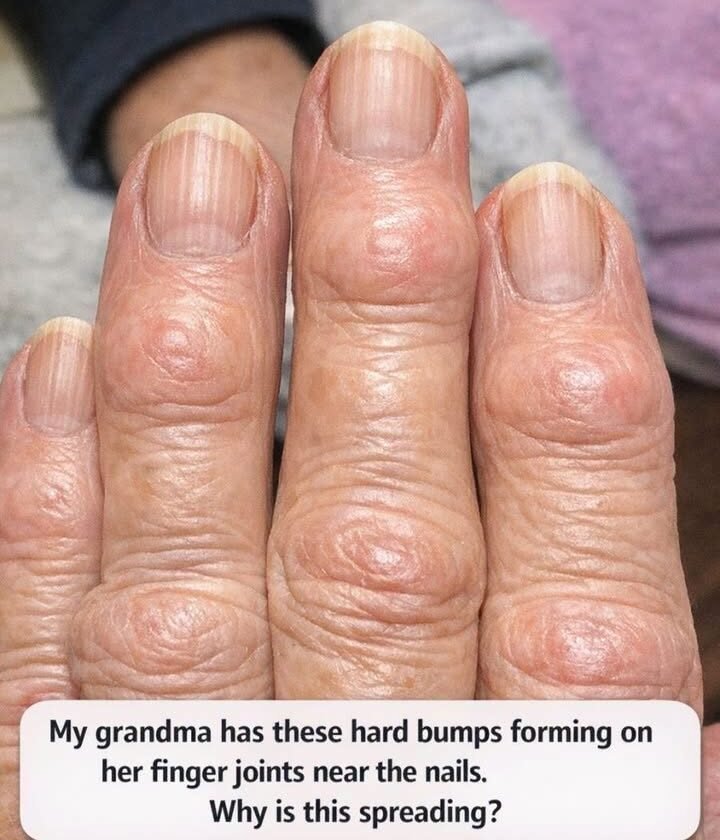
Hard bumps forming on finger joints near the nails in older adults are very common, and they usually point to one of two closely related conditions affecting the joints and surrounding tissue.
The two most likely causes for what your grandma is experiencing include:
1. Heberden’s Nodes (Bony Bumps)
-
What they are: These are hard, bony enlargements that form specifically on the joint closest to the fingernail (the distal interphalangeal joint).
-
Why they form: They are a hallmark sign of osteoarthritis in the hands. Over time, the cartilage cushioning the joint wears down, and the body responds by growing small spurs of bone (osteophytes) around the edges of the joint.
-
Why it seems to be “spreading”: Hand osteoarthritis frequently affects multiple fingers symmetrically or progressively across both hands. As the wear-and-tear process continues, similar bumps (called Bouchard’s nodes if they appear on the middle joints) can gradually show up on other fingers over time.
2. Digital Mucous Cysts (Myxoid Cysts)
-
What they are: If the bumps look a bit more smooth, shiny, or dome-shaped, or if they cause a small dent or ridge to grow lengthwise down the fingernail, they may be digital mucous cysts.
-
Why they form: These are small, fluid-filled sacs closely related to underlying joint wear or arthritis. They develop when joint fluid leaks out into the surrounding tissue, often via a tiny “stalk” connected to the arthritic joint right next to the nail. They can sometimes appear on multiple fingers if multiple joints are undergoing similar wear.
Important Safety Note: What NOT to Do
-
Never try to pop, squeeze, or pierce these bumps (especially if they look like fluid-filled cysts). Because they are often directly connected to the joint space, puncturing them at home creates a high risk of introducing bacteria, which can lead to a severe and painful deep joint infection.
What Your Grandma Should Do
She should schedule a visit with her primary care doctor, a rheumatologist, or an orthopedic hand specialist. A simple physical evaluation—often paired with an X-ray of the hands—can confirm whether these bumps are driven by osteoarthritis or mucous cysts. From there, a professional can offer safe management options, ranging from protective splinting and topical anti-inflammatories to specialized treatments for the cysts if they begin causing pain or skin thinning.
Is she experiencing any pain, stiffness, or trouble using her hands when she tries to grip things?