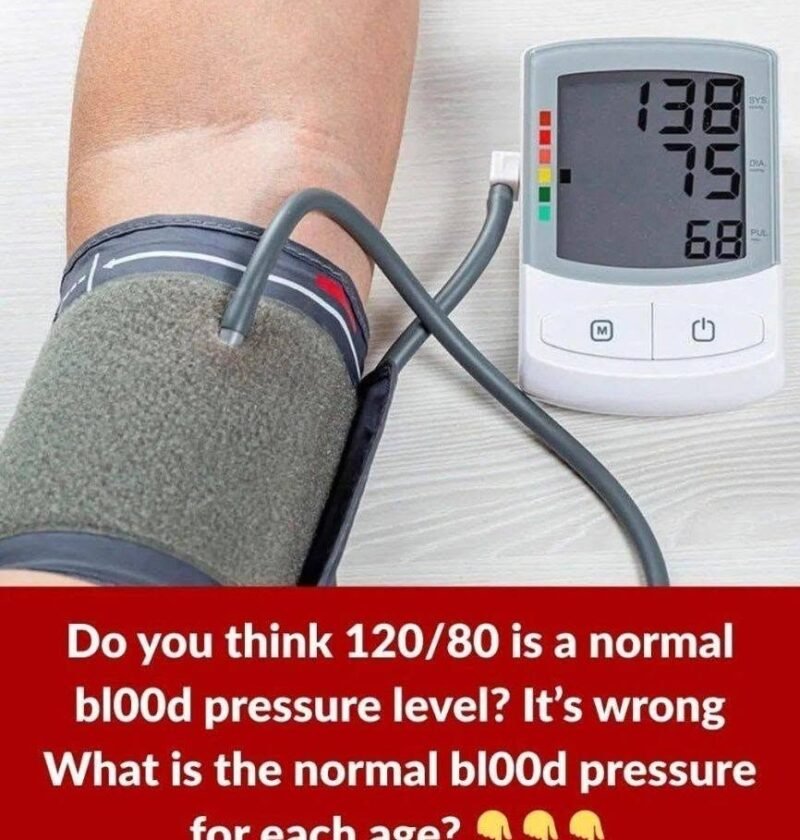
A common misconception is that “normal” blood pressure increases as you get older (such as the old rule of thumb: “100 plus your age”). However, major medical guidelines—including those from the American Heart Association (AHA) and American College of Cardiology (ACC)—establish that the clinical definition of normal blood pressure is the same for all healthy adults: less than 120/80 mmHg.
While average or “typical” blood pressure readings do tend to rise with age because blood vessels naturally stiffen over time, what is common is not necessarily ideal or risk-free.
Standard Adult Blood Pressure Categories (AHA/ACC)
| Category | Systolic (Top Number) | Diastolic (Bottom Number) | |
| Normal | Less than 120 | and | Less than 80 |
| Elevated | 120 to 129 | and | Less than 80 |
| Stage 1 Hypertension | 130 to 139 | or | 80 to 89 |
| Stage 2 Hypertension | 140 or higher | or | 90 or higher |
| Hypertensive Crisis | Higher than 180 | and/or | Higher than 120 (Seek immediate medical care) |
(Note: If the two numbers fall into different categories, the higher category rules. For example, a reading of 122/86 mmHg is classified as Stage 1 Hypertension because the bottom number falls into the 80–89 range.)
How Blood Pressure Trends Across Decades
Even though the healthy target remains under 120/80 mmHg throughout life, population averages shift as people age:
-
Young Adults (18–39): Averages typically sit around 110–120 / 68–78 mmHg. Maintaining healthy habits early prevents the arterial stiffening that drives up pressure later in life.
-
Middle Age (40–59): Averages drift upward to roughly 120–130 / 74–82 mmHg. The top (systolic) number often begins its gradual climb during these decades.
-
Older Adults (60+): Averages commonly reach 130–140 (or higher) over 68–80 mmHg. In this age group, the top number frequently continues to rise while the bottom number may level off or drift down.
While physicians sometimes individualize treatment goals for older adults—balancing cardiovascular protection with factors like overall health, frailty, or medication tolerance—consistently reading in the 140/90 range or higher still indicates high blood pressure that merits medical attention.
Are you checking your blood pressure at home or tracking a specific reading you recently received?