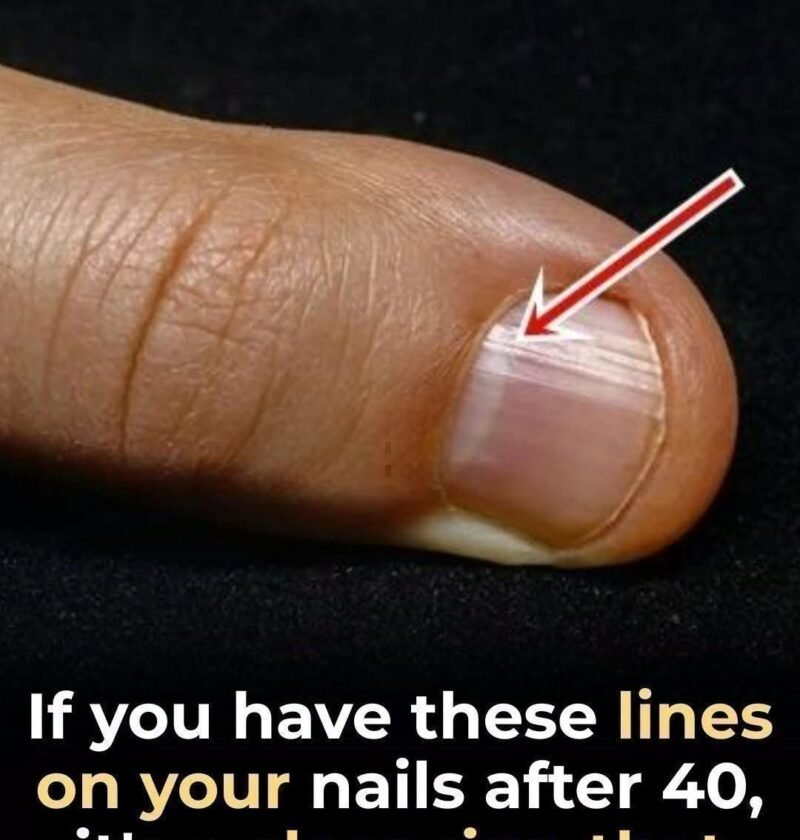
Headlines like “Why Vertical Lines on Your Nails Often Appear With Age” (often circulated in syndicated wellness feeds alongside extra tag words or author/site strings) usually imply that fine vertical ridges on fingernails signal a hidden vitamin deficiency, poor circulation, or internal organ stress.
In dermatology, fine vertical ridges running from the cuticle to the tip of the nail (longitudinal striations or onychorrhexis) are a normal, benign part of nail aging—essentially the fingernail equivalent of fine wrinkles on skin. As the nail root (nail matrix) ages, cell turnover slows and becomes slightly less uniform, creating shallow lengthwise grooves that become much more noticeable after age 40–50.
Harmless Vertical Ridges vs. Nail Changes That Need a Doctor
| Nail Appearance | What It Usually Means | Action Needed |
| Fine, even vertical ridges on multiple nails (especially gradually appearing after age 40) | Normal nail aging and surface dryness; moisture loss makes existing grooves look deeper. | No medical treatment needed. Moisturize nails/cuticles regularly and keep nails trimmed short. |
| Vertical ridges paired with severe splitting, peeling, or spoon-shaped (concave) nails | Can reflect chronic wet-dry chemical wear, iron deficiency (low ferritin), or thyroid imbalance (hypothyroidism). | Wear gloves for dishwashing; ask a doctor about CBC, ferritin, and thyroid (TSH) if accompanied by fatigue, hair shedding, or brittle toenails too. |
| Horizontal grooves running side-to-side across nails (Beau’s lines) | Temporary pause in nail growth caused by a past high fever, severe illness, major stress, chemotherapy, or uncontrolled diabetes weeks earlier. | Worth discussing with a doctor if you didn’t have an obvious recent illness or if grooves recur. |
| A single dark brown or black vertical band (longitudinal melanonychia) | Can be harmless pigment in darker skin tones—but on a single nail, especially if widening or staining the cuticle (Hutchinson’s sign), it must be evaluated to rule out subungual melanoma. | Prompt dermatology exam for any new or changing dark vertical streak on one nail. |
| Tiny pinpoint dents (pitting), yellowish thickening, or nail lifting off the bed | Common with nail psoriasis, eczema, or fungal infection (onychomycosis). | See a primary care doctor or dermatologist for proper diagnosis before buying over-the-counter nail treatments. |
Safe Nail Care vs. Mistakes to Avoid
-
Do NOT aggressively buff vertical ridges flat: Heavy buffing thins the upper keratin layers, making nails weak, sensitive, and prone to splitting. Light smoothing once a month is the maximum, or skip buffing altogether.
-
Lock in moisture daily: Rub plain petroleum jelly, thick hand cream, or jojoba/mineral oil over the nail plate and cuticle after washing hands—hydrated keratin swells slightly, making vertical lines look much smoother naturally.
-
Protect hands from harsh detergents: Wear cotton-lined rubber gloves when washing dishes or cleaning, as repeated water and soap exposure accentuates lengthwise grooves.