That headline combines a classic school-night anxiety—sleeping in the same bed with someone who has lice—with a startling, visceral clickbait hook: “Eyelash lice.”
While head-to-head contact or sharing bedding can transmit standard head lice, the idea of “eyelash lice” sounds like a terrifying fiction. However, eyelash lice are medically real, though they are completely different from ordinary head lice.
Here is the clinical truth about sleeping with someone who has lice, what eyelash lice actually are, and how to spot the difference.
Part 1: Sleeping With Someone Who Has Head Lice
If someone in your house (like a child) has standard head lice (Pediculus humanus capitis) and you share a bed or pillows, transmission is entirely possible, but not quite as effortless as clickbait suggests.
-
How they spread: Head lice cannot jump, hop, or fly—they crawl. They spread primarily through direct, prolonged head-to-head contact (when hairs touch) or, less commonly, by crawling onto shared pillows, hats, or hairbrushes.
-
The pillow myth: While sleeping on the same pillow can pass a crawling louse, adult lice survive less than 24 to 48 hours away from a human scalp because they need regular blood meals and body heat.
-
The bottom line: If your partner or child has head lice, you don’t necessarily need to banish them from the bedroom forever, but you should avoid sharing pillows, hairbrushes, towels, or head-to-head contact until their treatment is complete.
Part 2: The Truth About “Eyelash Lice” (Phthiriasis Palpebrarum)
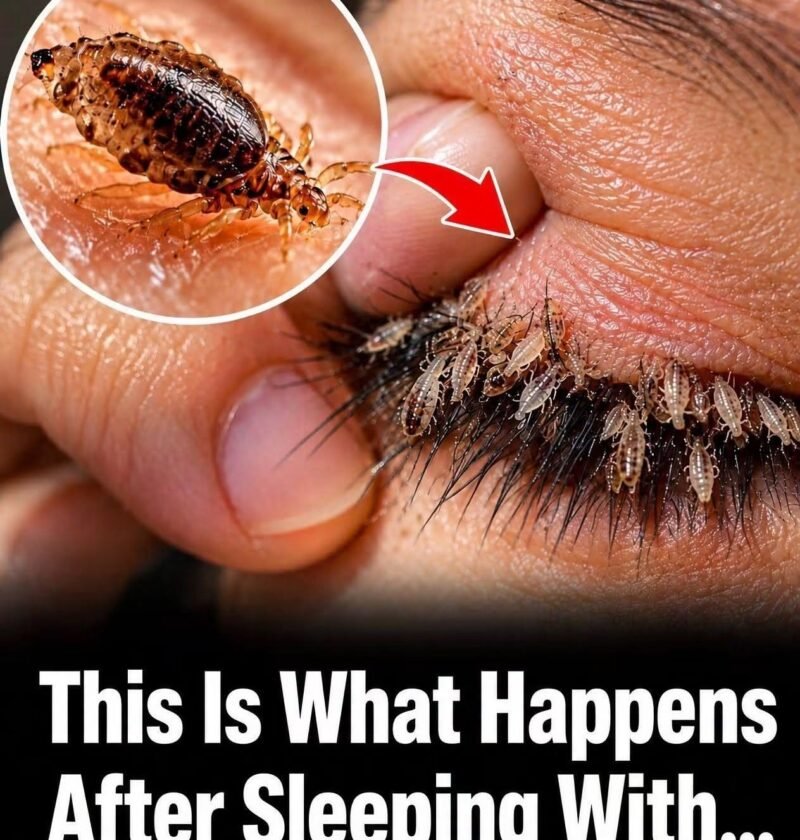
When viral articles scream about “eyelash lice,” they are usually referring to pubic lice (Pthirus pubis, commonly known as “crabs”) that have migrated from the pubic region to coarser facial hair, specifically the eyelashes and eyebrows.
While head lice never live on eyelashes, pubic lice are uniquely adapted to grasp hairs that are spaced wider apart—making eyelashes and eyebrows an ideal secondary home.
-
How they get there: Transmission to the eyelashes almost always occurs via direct physical contact with an active infestation elsewhere on the body (or transferring them from the genital area to the eyes via unwashed hands). It is virtually never caught from a casual hug, sharing a drinking glass, or sleeping next to someone with standard head lice.
-
What it looks like: People with eyelash lice experience intense, persistent eye itching, redness, and inflammation along the eyelid margin (blepharitis). If you look closely (or a doctor uses a slit-lamp microscope), you can spot tiny, crab-like translucent bugs clinging firmly to the base of the eyelashes, alongside tiny white nits (eggs) glued tightly to the hair shafts.
-
How doctors treat it: Standard head lice shampoos cannot be used near the eyes because they will severely damage the cornea. Instead, doctors treat eyelash lice by mechanically removing the bugs and nits with specialized fine-toothed forceps or applying safe, medical-grade ophthalmic ointments (such as petroleum jelly or specific medicated ointments) that suffocate the lice over several days.
Quick Summary: Head Lice vs. Eyelash “Crab” Lice
| Feature | Standard Head Lice | Eyelash Lice (Phthiriasis Palpebrarum) |
| Where they live | Scalp hair exclusively. | Eyelashes and eyebrows (migrated from pubic areas). |
| How you catch them | Head-to-head contact or shared pillows/brushes. | Direct transfer from pubic areas via unwashed hands or close contact. |
| Can they jump/fly? | No (they only crawl). | No. |
| Treatment | Over-the-counter permethrin or pyrethrin lotions + fine-toothed nit combing. | Medical eye ointments and careful manual removal by a doctor (no harsh head lice chemicals near eyes!). |
When to See a Doctor: If you or a family member develop an itchy, red scalp with visible bugs or tiny white specks stuck to hair shafts, treat it with standard over-the-counter pediculicides. However, if you develop persistent, unexplained eyelid itching, crusting, or inflammation along your eyelashes, skip the drugstore lice shampoo and see an optometrist or ophthalmologist to safely rule out or treat eyelash mites or lice.