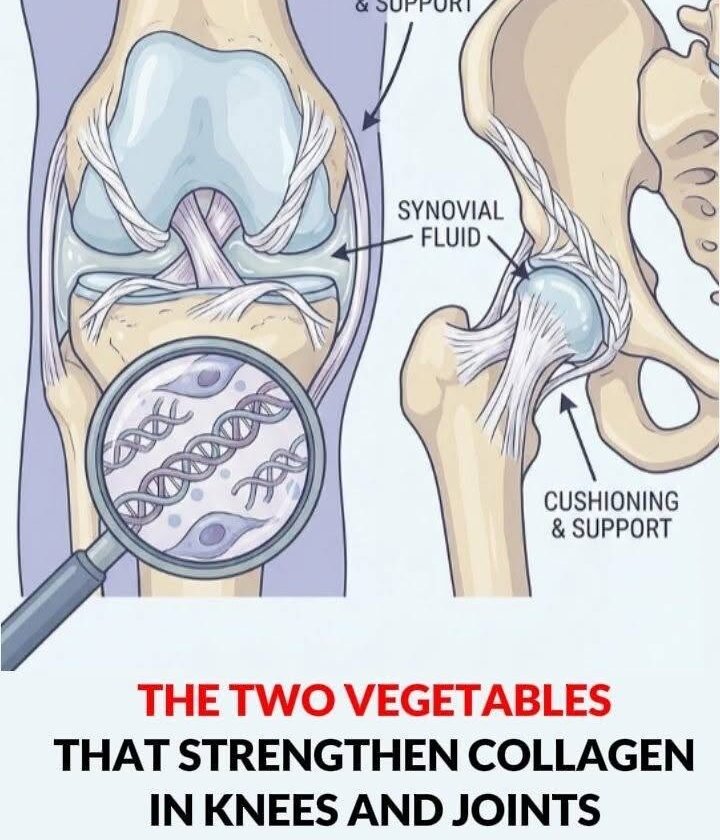
You will often see viral health articles and videos claiming that eating specific vegetables—such as onions, garlic, or dark leafy greens—can “rebuild collagen” in your knees and joints almost like magic.
While certain vegetables provide valuable nutrients that support joint health, the biological reality of how your body builds and maintains joint cartilage is a bit more nuanced.
The Reality Behind “Collagen-Rebuilding” Vegetables
Collagen is the most abundant protein in your body, providing structural support to your skin, tendons, ligaments, and the cartilage inside your joints. When people talk about vegetables that support collagen, they are usually referring to sulfur-rich or antioxidant-packed produce like onions, garlic, broccoli, and leafy greens.
Here is what these vegetables actually do for your joints:
-
They Provide Essential Building Blocks: Vegetables high in Vitamin C (like bell peppers, broccoli, and kale) are necessary for your body to synthesize pro-collagen, the precursor to collagen. Without enough Vitamin C, your body cannot efficiently cross-link collagen fibers.
-
They Deliver Sulfur and Antioxidants: Vegetables in the allium family (garlic and onions) are rich in sulfur, which is used by the body to help stabilize collagen structural integrity. Antioxidants in these vegetables also help reduce inflammation in joint tissues.
What Vegetables Cannot Do
-
They Don’t Directly Replace Joint Cartilage: When you eat vegetables, your digestive system breaks their proteins and vitamins down into individual amino acids and nutrients. Your body cannot simply take vegetable compounds and paste them directly onto worn-out knee cartilage.
-
Cartilage Has Limited Blood Supply: Unlike skin or muscle, articular cartilage (the cushion inside your knee joint) has very poor blood flow. This makes it notoriously difficult for the body to naturally repair or “rebuild” once it has worn down from arthritis, injury, or aging.
Proven Ways to Support Knee and Joint Health
While no single vegetable is a miracle cure for joint wear and tear, medical professionals recommend several evidence-based strategies to protect and maintain knee joints:
-
Maintain a Healthy Weight: Every extra pound of body weight puts about four pounds of pressure on your knees when walking. Losing even a modest amount of weight significantly reduces joint stress.
-
Strengthen Supporting Muscles: Building strength in your quadriceps, hamstrings, and calves helps stabilize the knee joint and absorbs impact, protecting the cartilage underneath.
-
Low-Impact Exercise: Activities like swimming, cycling, or walking keep the joints lubricated by promoting the circulation of synovial fluid without the pounding impact of high-intensity running.
-
Medical Interventions: If you are experiencing chronic knee pain, stiffness, or joint damage, treatments ranging from physical therapy to anti-inflammatory medications, hyaluronic acid injections, or specialized medical therapies can provide relief that diet alone cannot.
Are you currently managing any knee discomfort or looking for ways to support your joint health as you stay active?