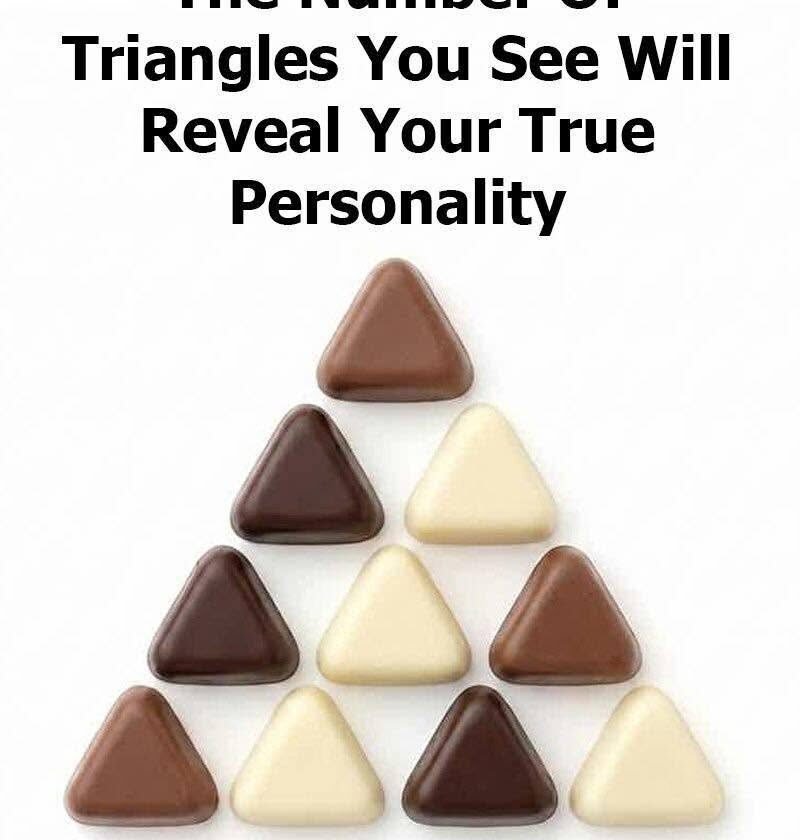
While internet personality quizzes that claim to reveal your entire psychological profile by counting triangles in a complex geometric optical illusion are pure entertainment rather than validated science, they tap into a very real psychological phenomenon: visual processing and cognitive style.
When people look at these nested or overlapping triangle puzzles, they often come away with radically different counts. What actually determines how many triangles you see—and what that says about your brain—comes down to how your visual cortex processes information.
Why People See Different Numbers of Triangles
1. Global vs. Local Processing (Gestalt Psychology)
-
The “Big Picture” Processors: Some people immediately see the large outer triangle encompassing everything else, along with a few major intersecting lines. Their brains naturally practice global processing, prioritizing the overarching shape before breaking it down into smaller components.
-
The “Detail-Oriented” Processors: Other people meticulously scan every individual vertex, sub-triangle, and overlapping section, counting dozens of tiny constituent shapes. Their brains lean toward local processing, focusing intensely on fine details and individual elements.
2. Pattern Recognition and Closure
-
The Brain’s Shortcut: The human brain is hardwired for closure—the Gestalt principle where our visual system automatically fills in missing gaps to perceive complete, recognizable shapes (like triangles) even when lines are fragmented or intersecting.
-
Depending on how strongly your brain’s pattern-matching filters are tuned at that moment, you may “see” hidden triangles formed by intersecting lines that someone else completely overlooks.
3. Cognitive Fatigue and Attention
-
Visual puzzles of this nature are heavily influenced by your immediate state of focus. If you are tired, distracted, or scanning quickly, your brain takes mental shortcuts and misses overlapping intersections, resulting in a lower count. If you are deeply focused, methodical, and patient, you will inevitably spot more hidden shapes.
What It Really Reveals (Beyond the Clickbait)
While it won’t decode your deepest secrets, cognitive tests like this do offer a fun snapshot of your cognitive style:
-
High counts often reflect strong attention to detail, analytical patience, and methodical problem-solving.
-
Low-to-moderate counts often point to a macro-level, big-picture thinking style that grasps overall concepts quickly without getting bogged down in minutiae.