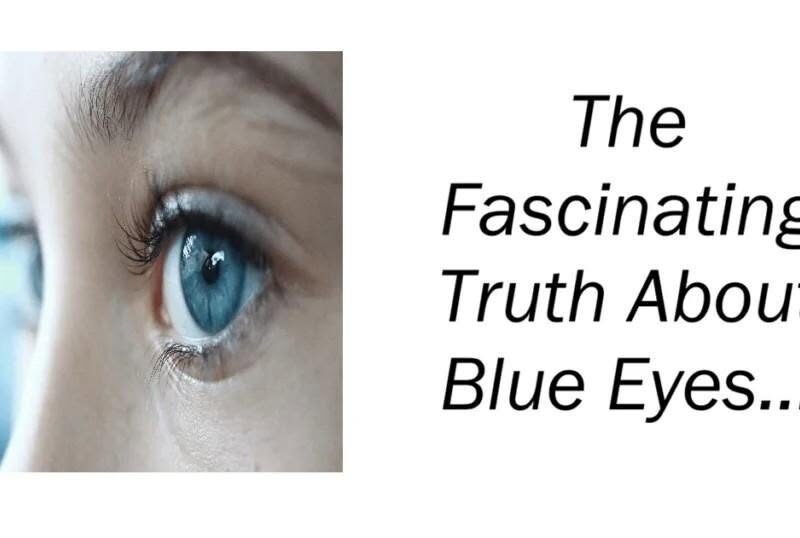
The Fascinating Truth About Blue Eyes 👁️
Blue eyes are beautiful, but the science behind them is even more fascinating. Their color comes from the way light interacts with the iris, and their genetic history reveals something remarkable about human ancestry.
1. Blue eyes don’t actually contain blue pigment
Unlike brown eyes, which contain relatively high amounts of melanin, blue eyes generally have much less melanin in the front layer of the iris.
The blue appearance comes mainly from light scattering within the iris. Shorter blue wavelengths are scattered back toward the observer more strongly, creating the color we see. This is similar to why the sky appears blue.
2. Blue eyes are linked to specific genes
Two important genes are HERC2 and OCA2, located close together on chromosome 15. They influence how much melanin is produced in the iris. Variations in these genes contribute significantly to whether a person’s eyes appear blue, green, hazel, or brown. Other genes also play a role.
3. Do all blue-eyed people share a common ancestor?
Scientists have proposed that a genetic variant responsible for many cases of blue eyes spread from a common ancestor thousands of years ago. One influential study suggested a shared ancestral origin for a major blue-eye-associated variant.
However, eye color is genetically complex, and blue eyes can arise through different combinations of genetic variants. It would be an exaggeration to say that every blue-eyed person today necessarily descends from one single blue-eyed individual in a simple, direct lineage.
4. Blue eyes can appear to change color
Blue eyes may appear brighter, grayer, or more vibrant depending on:
-
Lighting and the surrounding environment.
-
Clothing and makeup colors.
-
Pupil size, which changes the visible appearance of the iris.
-
The camera’s white balance and image processing.
The actual iris pigment generally does not change dramatically from moment to moment. The apparent color change is usually an optical effect.
5. Are blue eyes more sensitive to sunlight?
People with lighter-colored eyes have less iris pigment, and some studies suggest eye color may be associated with differences in light sensitivity. However, blue eyes do not automatically mean someone has poor vision or a serious eye problem.
Everyone should protect their eyes from ultraviolet radiation with sunglasses that provide proper UV protection.
6. Blue eyes are relatively uncommon worldwide
Blue eyes are much more common in some European populations than in many other parts of the world. Their prevalence varies considerably by ancestry and region, so there is no single reliable percentage that applies to every population.
Brown eyes remain the most common eye color globally.
7. Can two brown-eyed parents have a blue-eyed child?
Yes! Eye color does not follow a simple one-gene, dominant-versus-recessive rule. Two brown-eyed parents may carry genetic variants associated with lighter eyes and have a blue-eyed child.
Likewise, two blue-eyed parents can occasionally have a child with brown eyes. Multiple genes influence the outcome.
The bottom line
Blue eyes are a fascinating example of how genetics and the physics of light work together. Their beauty comes not from a blue pigment, but largely from the way a lightly pigmented iris scatters light.
One important reminder: Eye color does not determine a person’s personality, intelligence, or character. Those popular claims are not established scientific facts.