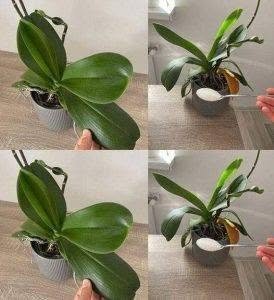
Orchids: “Just 1 tablespoon and they will bloom non-stop” — what’s really true?
This kind of headline is usually clickbait. There is no universal 1-tablespoon fertilizer that will make an orchid bloom continuously. Flowering depends on several factors, especially light, temperature, watering, healthy roots, and appropriate nutrition. The American Orchid Society specifically notes that insufficient light is the most common reason orchids fail to rebloom.
What fertilizer actually does
Fertilizer supplies nutrients such as nitrogen, phosphorus and potassium. It supports healthy roots, leaves and flowers, but it is not the plant’s food—light provides the energy through photosynthesis. Orchids naturally grow in relatively nutrient-poor environments, so excessive fertilizer can cause salt buildup and root or leaf damage.
For many commonly grown orchids, a complete balanced fertilizer such as 20-20-20, containing micronutrients, is a reasonable choice. Experienced orchid growers generally recommend using no more than half the strength stated on the fertilizer label.
About the “1 tablespoon” claim
The important question is 1 tablespoon of what, diluted in how much water?
A tablespoon of fertilizer concentrate added directly to an orchid pot could be far too strong. The safe amount depends on:
- the fertilizer’s N-P-K formulation;
- whether it is liquid, powder or granules;
- how much water it is mixed into;
- the orchid species;
- water quality and existing salt buildup.
For example, the American Orchid Society gives a much more dilute approach for regular feeding: one example calculates only about ¼ teaspoon of a 30-10-10 fertilizer per gallon of water for weekly feeding.
A safer approach for a Phalaenopsis orchid
For a typical supermarket moth orchid (Phalaenopsis):
- Keep it in bright, suitable light. Insufficient light is a major cause of poor flowering.
- Water thoroughly when the growing medium is approaching dryness, allowing excess water to drain.
- Use a complete orchid fertilizer at diluted strength, following the product label rather than blindly measuring a tablespoon.
- Fertilize during active growth; reduce feeding when growth slows.
- Periodically flush the pot thoroughly with plain water to help remove accumulated fertilizer salts.
Bottom line: A tablespoon isn’t a magic flowering dose. If you’ve seen a particular recipe claiming that 1 tablespoon of something—such as rice water, banana fertilizer, Epsom salt, cinnamon, or another household ingredient—makes orchids bloom nonstop, tell me the ingredient. I can check that specific recipe and give you the correct dilution and whether it’s safe for orchids.