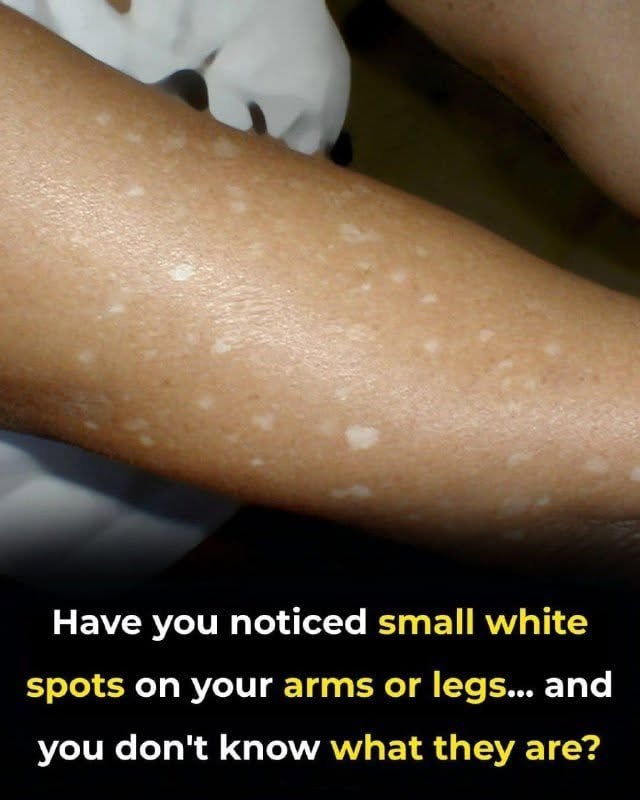
⚪ Small White Spots on Your Arms or Legs: What Could They Be?
Small white spots are often harmless, but their appearance, location, and whether they’re changing can help narrow down the cause.
Common possibilities
- Idiopathic guttate hypomelanosis (IGH): Tiny, flat, smooth white spots—often on the forearms and shins—becoming more common with age and cumulative sun exposure. They’re harmless and aren’t contagious.
- Tinea versicolor: A superficial fungal/yeast infection that can produce lighter or darker patches, sometimes with fine scaling. It commonly affects the trunk, shoulders, and upper arms.
- Vitiligo: Areas where pigment-producing cells are lost, creating sharply defined pale or completely white patches. It can occur anywhere and may gradually enlarge.
- Post-inflammatory hypopigmentation: Skin can temporarily lose some pigment after eczema, irritation, injury, or another rash has healed.
- Sun-related changes: Long-term UV exposure can contribute to several forms of uneven pigmentation.
When should you get them checked?
See a dermatologist or clinician if the spots are rapidly spreading, becoming completely white, itchy or scaly, painful, bleeding, or associated with other skin changes. A new widespread change in pigmentation also deserves evaluation.
Don’t assume every white spot is a fungal infection and start using antifungal products without identifying the cause—vitiligo and IGH require different approaches.
Bottom line: If the spots are tiny, flat, stable, and mostly on the arms or legs of an older adult, idiopathic guttate hypomelanosis is one common possibility, but a photo and examination are needed for a reliable diagnosis.