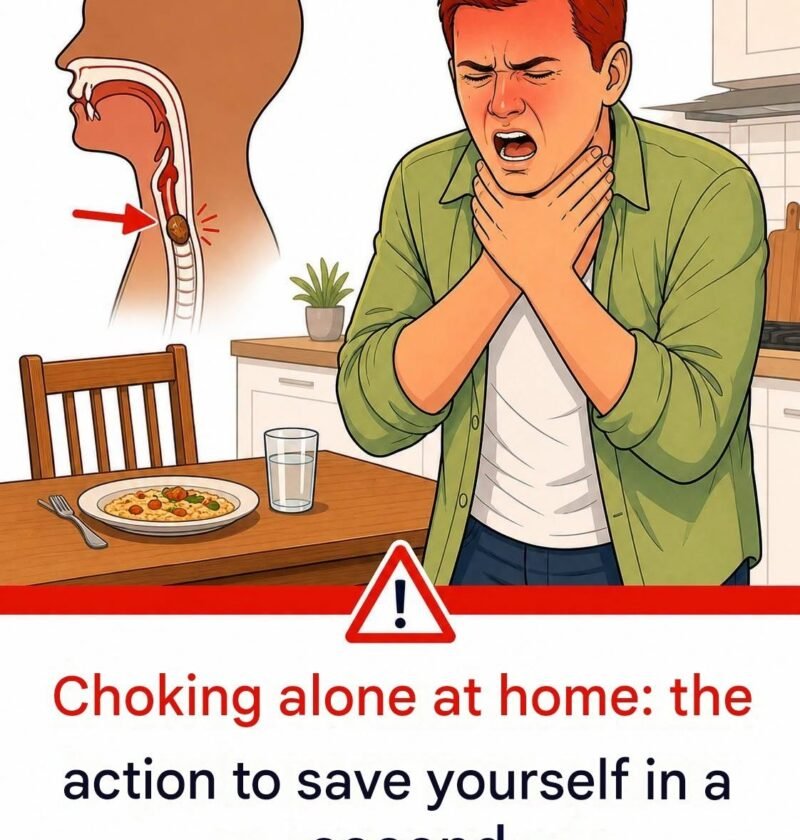
While online videos love to frame life-saving first-aid techniques with dramatic “secret trick” headlines, the actual maneuver taught by emergency responders, firefighters, and medical professionals is a well-established procedure: performing a self-administered Heimlich maneuver (abdominal thrusts).
When you are completely alone and a piece of food blocks your airway, every second counts. Because you don’t have someone behind you to wrap their arms around your waist, you have to use your own body weight and leverage to create the necessary upward pressure.
Here is the exact method emergency responders instruct people to use:
How to Perform the Self-Heimlich Maneuver
-
Make a Fist: Make a tight fist with one hand. Place the thumb side of your fist against your abdomen—slightly above your belly button but well below your rib cage.
-
Grasp Your Fist: Grasp your fist firmly with your other hand.
-
Use a Hard Surface for Leverage: Bend completely over a fixed, rigid object at waist height—such as the back of a sturdy chair, a table edge, a countertop, or even a porch railing.
-
Drive Inward and Upward: Shove your fist hard into your upper abdomen with a quick, forceful upward thrust (as if you are trying to lift yourself up off the floor using your hands). Simultaneously, press your upper belly area sharply against the edge of the chair or counter.
-
Repeat Until Cleared: Continue these rapid inward and upward thrusts until the blocked object is successfully dislodged or coughed out.
A Critical Note on Calling for Help
If you are choking and live with a smart device, mobile phone, or landline nearby, try to dial emergency services (like 911) and leave the line open even if you cannot speak—dispatchers are trained to trace calls or recognize silence as an emergency. However, if you cannot reach a phone, your immediate physical priority is executing those self-thrusts instantly before oxygen levels drop.
Have you ever taken a standard first-aid or CPR course that covered choking rescue techniques?